CHAPTER TWENTY-ONE
“PARALYZE THE WILL”
On the day the sedition trial resumed, in the first week of September 1944, a surprise visitor arrived in Judge Eicher’s courtroom. Eicher needed this like a hole in the head. He had already spent his first day back from his much-needed vacation wading through all the paper that defense lawyers had dumped on his desk in his absence. The Washington Post called it “ an avalanche of motions of mistrial, severance of some defendants from the case, squashing indictments, and ruling out of evidence.” The motions, which varied from nonsensical, to irrelevant, to contemptible, sorely tested Judge Edward Eicher’s normally deep reserve of calm and general equanimity. Now, on top of that, into Eicher’s already unruly courtroom strutted Senator William “Wild Bill” Langer, whose reputation preceded him and whose own insurrectionist past had quite nearly precluded him from being seated in the Senate. Langer “was not someone who practiced the fine art of reason and compromise,” says historian Nancy Beck Young. “His style was aggressive and in your face. And he saw this as a headline-grabbing moment. He saw it as a way to poke a stick in the eye of the [Roosevelt] administration.”
Langer had already secretly provided one of the defendants with a lawyer—a lawyer whom Eicher had then tossed off the case for bad behavior back in July. The senator made multiple visits to the D.C. jail to show his solidarity with eight defendants who spent the duration of the trial in custody because they were unable to make bail. He socialized openly with the defendant Elizabeth Dilling, who could afford bail; Langer even hosted her for conferences at his Senate office.
Now, in the courtroom, Wild Bill threw his arm around some of the defendants, whispered unheard confidences with them, laughed with them, made his presence in the courtroom in support of them as ostentatious as he possibly could. He spent a good bit of time in serious conversation with Nazi agent George Sylvester Viereck, mastermind of the Hitler government’s propaganda operation in America. As disruptive as Langer was to the already nearly ungovernable proceedings, Eicher couldn’t exactly shoo a sitting U.S. senator from his courtroom. Well, theoretically he could, but Eicher would never.
After two days at the trial, Wild Bill was back in the Senate chamber, where he commandeered the floor to call for the dismissal of all charges against all the defendants in the sedition trial. Eicher’s court was in recess that day, so among the spectators in the gallery for Langer’s speech was the defendant Lawrence Dennis (who might himself have been the author of a good bit of Langer’s oration). The senator spoke for more than two hours. He cast the defendants who were being held in the D.C. jail as “political prisoners.” The trial was a “legal farce” and a “preversion [sic] of justice.” The defendants were all great people, Langer asserted, great Americans. Langer’s characterizations elided much. Lawrence Dennis, on the payroll of Hitler’s government and America’s foremost fascist intellectual, was in Langer’s telling just “a man of moderate means…defending himself as his own attorney and room[ing] here with his wife and two small daughters.” George Deatherage, the former Klansman who was also funded by the Germans and who had set up armed cells around the country to overthrow the U.S. government after the 1940 election, was described blandly by Langer as an “industrial efficiency engineer with a son fighting in the service.” Lois de Lafayette Washburn (Sieg Heil!) was a simple woman who made her living doing housework. “The son of the other woman defendant, who is Mrs. Elizabeth Dilling, graduated on March 4 from officer candidate school, but a few hours before graduation his commission was withheld, allegedly…because his mother is a defendant in this trial.”
The “allegedly” was doing a lot of work in that sentence. Senator Langer did not mention that Kirkpatrick Dilling was reportedly in danger of being stripped of his corporal’s stripes because, just the previous day, he had joined his mother in attacking a young member of the U.S. Army Air Corps as a “God-damn Jew” and reminding the serviceman that “the Jews have been driven out of Europe and you’ll all be driven out of this country too.”
The German-supported antisemitic publisher and General Moseley water taster, Charles B. Hudson, was a man with “a small home-mimeographed bulletin,” said Langer. “His wife kept roomers, and for several years he was unable to get his teeth fixed because of lack of money.” (Dental health was an unexpected theme running through this trial.) Another defendant wrote hymns and taught Bible classes.
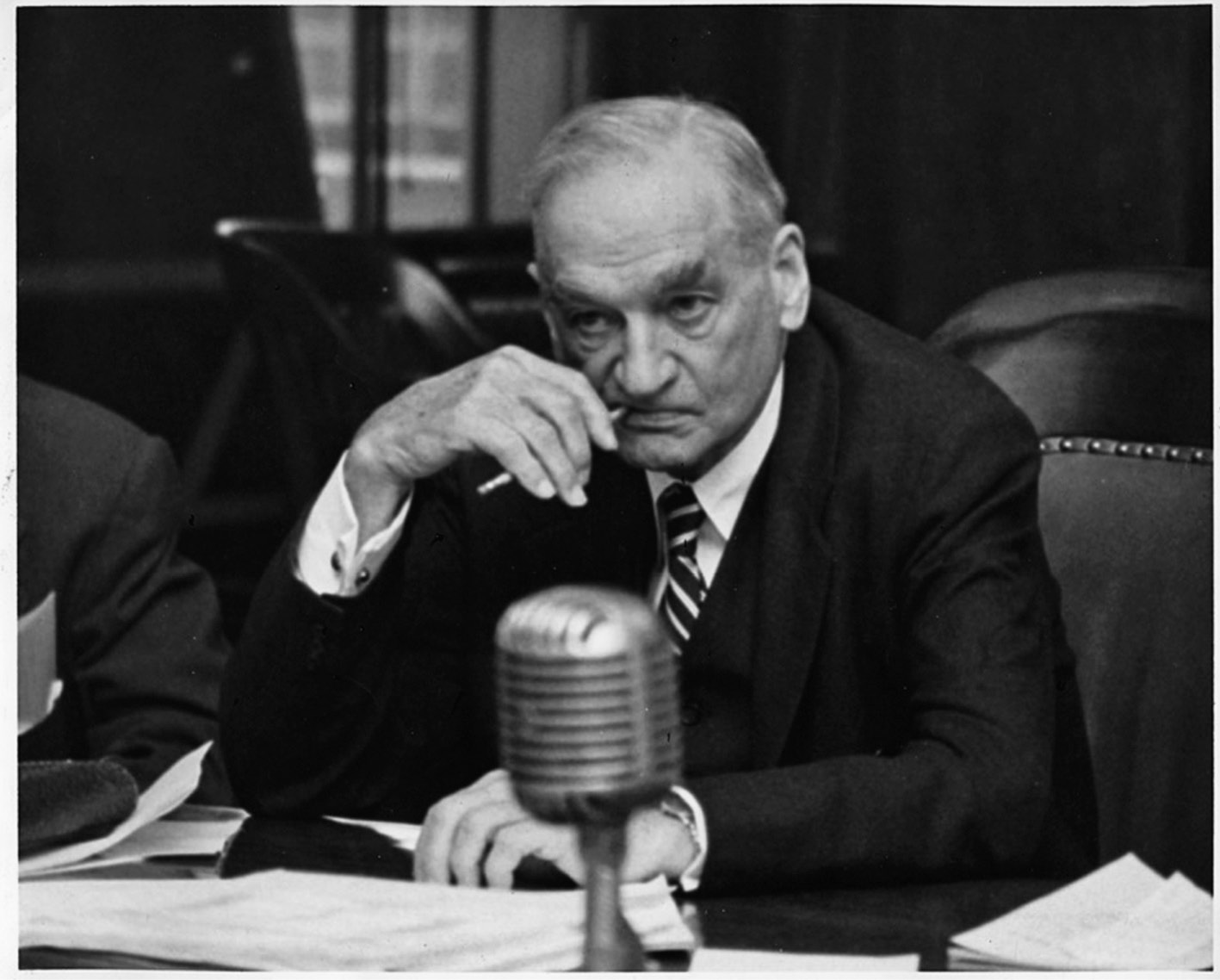
William “Wild Bill” Langer near the end of his long career in the U.S. Senate
What Langer really wanted etched into the Congressional Record was that these defendants simply posed no actual threat to America. They were “small fry…little old men and women who have no more influence than a rooster.” Langer demanded that Attorney General Biddle call off his dogs, and even offered him a script to do so: “Developments have demonstrated that some of these defendants, if guilty of reprehensible conduct toward the country, are either actually demented or approximately insane—at least to the point of belonging distinctly to the lunatic fringe.” Maybe they engaged in some unfortunate activity, Langer conceded, but “the evidence shows, however, that these efforts were impotent and characteristic of a general conduct of these defendants, relatively ineffective.”
In the courtroom, Rogge was still trying to beat down motion after motion, objection after objection, disruption after disruption, to make his case to the jury. Press coverage was waning precipitously by the middle of September. Even in Washington, D.C., where Rogge’s ordeal was playing out live, the daily coverage felt more like a series of sidebars—details about the color and texture and logistics of the case and not so much about the substance. For variety, stories occasionally ticked off updates on the named but unindicted German co-conspirators. Manfred von Killinger, for instance, who as Nazi consul in San Francisco had provided German support for the plot to lynch powerful figures in Hollywood, shot himself dead in Romania as the Russian army advanced on German positions. One less alleged co-conspirator for the indictment, then.
The Washington Evening Star worked up a juicy little feature on the logistics of feeding the eight sedition defendants who were being held in jail. The medical officer at the jail had worked out a strict dietary schedule, which was reportedly a step up from regular inmate fare, on account of the difficulties of the trial schedule. Fruit juice and eggs for breakfast, for staying power. Then a packed sandwich for lunch at the courthouse, where the defendants could also get hot soup and coffee. The alleged seditionists got two portions of beefsteak each week (but small portions). And because the prisoners returned to jail from the courthouse after the evening meal was over, the wardens had arranged to keep their dinner plates warm. Three of the eight had to be put on special diets—no fried chicken, no pork chops—because of tummy issues. The medical officer at the jail would not divulge the identities of the gastrically impaired to the Star’s intrepid reporter but did explain that the trio had been “nervous and jittery” while on the normal prison diet.
There were reports that the court-appointed defense attorneys, who were not being paid to provide counsel, had pleaded with Judge Eicher to shift trial hours to the afternoon and evening. The attorneys wanted their mornings free to make a living. There was also much speculation in the press about how long the trial would drag on. Some reporters figured the prosecution’s presentation might go into 1945. And with twenty-six separate defense cases to make after that…well, there was no telling. The auditor for the district court was able to knock down outlandish estimates that the trial was going to cost taxpayers upwards of $1 million; the actual cost to date, to the penny, was $65,819.73 going back to the early grand juries in 1941. He expected the final tally to come in around $85,000.
By the fall, any news of the sedition trial that editors deemed worthy of the front page was invariably below the fold. The headline stories were about the war in Europe, which had a way of making everything else seem much less urgent. Allied troops had taken the beaches of Normandy, on D-day, just a few weeks after Rogge began to mount his case for the prosecution. The Allied breakout across France followed in the next few weeks. A few days after Judge Eicher called the two-week summer recess, the Allies had liberated Paris from Nazi rule. Victorious Allied troops paraded down the Avenue des Champs-Élysées, through throngs of cheering liberated French, and just kept going. They chased the fleeing German military across France, Holland, Belgium, Luxembourg, and right up to the Siegfried line. “A solid front from the North Sea to the Mediterranean was formed by a junction of General George S. Patton’s 3rd Army and the 7th Army of Lt. General Alexander Patch,” the Washington Evening Star reported on the very same day it wrote up the story about the sedition defendants’ sour tummies. The first American columns had already crossed onto German soil, pointed straight for Berlin, “the first time since Napoleon’s day that an invading force from the west had entered Germany in more than patrol strength.”
The other big story that fall was the upcoming national election, which was drawing new figures into the campaign. Henry Hoke, the direct mail adman whose intrepid work had spurred the Department of Justice investigation into the illegal Viereck-led congressional franking operation, traveled to Chicago to support a candidate running against Representative Stephen Day, who had been one of Viereck’s most prolific and best-paid authors at Flanders Hall. Hoke also published his own book about the scandal in the lead-up to the election, in hopes that it might have a salutary effect on voter behavior. “ It is a sizzling document,” wrote an early reviewer of Hoke’s book, on September 10, 1944. “One can only say that ‘Black Mail’ should be read—and thoroughly—by every American.”
Eight weeks later, on November 7, 1944, the president who had been leading the country in the war against the Nazis, Franklin Delano Roosevelt, won an unprecedented fourth term, with 432 electoral votes to Thomas E. Dewey’s 99. Roosevelt’s Democrats gained twenty-two seats in the House and protected their whopping nineteen-vote cushion in the Senate. The beauty of that election, though, was in the finer details. Members of Congress who had been in on Viereck’s scheme paid the price. Robert Rice “Build a Wall” Reynolds lost his seat in the U.S. Senate and so did Gerald Nye. Stephen Day was shellacked in Illinois. The big get was Hamilton Fish, who suffered his first and only election defeat in twenty-five years. The campaign against him focused almost exclusively on his Nazi ties. The Republican presidential nominee, Dewey, who was also the governor of Fish’s home state, had felt the need to publicly repudiate the veteran congressman during the campaign.
Hamilton Fish was about as gracious a loser as you might expect. “ I admit, publicly, that my defeat should be largely credited to Communistic and Red Forces from New York City backed by a large slush fund probably exceeding $250,000,” he said. He added that he was “fearful that the overwhelming election of President Roosevelt is a step toward setting up a one-man and one-party government in our own country.”
IN THE FALL of 1944, the daily reporter contingent in the courtroom had dwindled from forty down to four “regulars,” according to The New York Times. The press and America in general had simply lost interest after more than six months of watching the prosecutorial wheels spinning in the mud. Washington reporter Carter Brooke Jones, one of the few “regulars,” estimated the word count—witness testimony, objections, motions made and denied and made and denied, and all the catcalls and caterwauling that made it into the record—at more than two million. “One at a time, please” was an oft-used phrase by Judge Eicher, though there was no way for the stenographer to convey in words the jurist’s depth of exasperation.
The transcript, which surpassed thirteen thousand pages in the middle of October, was overwhelming. It was impossible to parse even for reporters—who were trained and professional observers—let alone, presumably, for the regular-joe jurors. But for anyone willing to slog through it, it emerges in that record that in the weeks before and after the 1944 elections, John Rogge was beginning to unearth some fascinating artifacts. The trial, in substance, was becoming downright intriguing to anybody who was there to see it.
Rogge had been presenting evidence to make the case that the defendants were part of an analog worldwide web, operating in America, on a very specific mission. In mid-October, Rogge put Dr. Hermann Rauschning on the witness stand to expound on the man who created that web: unindicted co-conspirator No. 1 in Rogge’s indictment, Adolf Hitler.
Rauschning, a German national, had been an early acolyte of Hitler’s, drawn to National Socialism as a means to restore Germany to its former honor. He had been an occasional personal interlocutor of the führer’s during Hitler’s rise to power and his early days in office. But he lost his faith in Hitler’s vision. Rauschning left Hitler’s side and fled Germany in 1936, just as the Nazis were constructing their heinous anti-Jewish legal regime.
From his unique and unsettling perspective as a high-placed former Nazi, Rauschning had tried to tell the world about Hitler’s mad plans starting even before Germany began invading other sovereign nations. “Warning to the West” was the subtitle of his first book to reach a wide American audience, published in 1938. Rauschning had been met with plenty of wariness and criticism in 1938, before Hitler began his headlong run at world domination. But by the time of his appearance at the sedition trial, at the end of 1944, his warnings—viewed in hindsight—had clearly been prescient. With so many of his darkest prophecies about Hitler having come to pass, Rauschning made a very compelling and very expert witness.
In his testimony, Dr. Hermann Rauschning invited the jury into private dining rooms and Nazi leadership conferences circa 1933, when Hitler was gaming out the strategy and tactics he was already setting in motion to target America. Hitler had by then started sending special Nazi agents into major cities all over the United States. In fact, this was the moment Leon Lewis, in Los Angeles, first realized what Hitler was up to and began recruiting undercover agents to document it. Hitler had already sent a man to that crucial West Coast city to organize the Friends of New Germany and other civic programs. This included setting up the Aryan Book Store, which accepted and distributed tons of Nazi propaganda shipped in from Germany and secretly off-loaded at the ports of Los Angeles, San Diego, and San Francisco. It also included setting up Hitler Youth camps and training grounds for German American storm troopers all over the United States, as well as funding and encouraging the arming of the American ultra-right, through men like George Deatherage, Clayton Ingalls, Edward James Smythe, Lawrence Dennis, and William Dudley Pelley and his Silver Shirts. But what exactly was Hitler’s aim? Rauschning had the answer in his contemporaneous notes from conversations with Hitler himself.
“ Adolf Hitler said,” Rauschning explained in his testimony, “the United States was threatened with a bloody revolution. He said he would be able to make this revolution come to pass. He explained the methods by which he would be able to paralyze the national unity of the United States and the power of resistance in this country…. He said the cleavages in the [American] population could be widened to disunite the country.” This was talk Rauschning dated from 1933, but he said Hitler was still expounding on the subject a year later, just after the führer had murdered his political rivals in the Night of the Long Knives. Rauschning was in Hitler’s personal lair in Berlin when the führer, Goebbels, and other henchmen made plans to blanket America, Poland, France, and Great Britain with propaganda—“the artillery and trench warfare” of modern warfare, Hitler had called it. “We have to paralyze the will and national unity of [these] and other countries,” Hitler said. “The great issue was to liberate the world from the poison of democracy, with its degenerating doctrine of liberty and equality.”
Rauschning’s testimony, in other words, was that the Nazi game plan aimed to disunite the United States by tearing at the weakest political and cultural seams in American society: the divide between haves and have-nots, fear and hatred of immigrants, white supremacist race hate, and antisemitism. Rogge’s job before the jury was to prove that these disparate defendants were part of that plan. The question before the court was whether their actions, in fact, constituted a seditious conspiracy.
Right before Thanksgiving, Rogge called an extraordinary witness to help answer that thorny question: this was Henry Allen, one of William Dudley Pelley’s key Silver Shirts, founder of the American White Guard, and confederate of, well, just about every defendant in the sedition trial. This was an incontrovertible fact, and the proof resided in Allen’s own briefcase. The briefcase Allen had left behind in his midnight-blue Studebaker Commander, very near his “kike killer” weapon, when he went to San Diego to snowstorm the city’s downtown with antisemitic flyers. The briefcase the San Diego police had confiscated after spymaster Leon Lewis and Charles Slocombe (Agent C19) had alerted them to its existence. The briefcase Lewis and Slocombe had rushed to retrieve before Allen was let out of jail. The briefcase Lewis and Slocombe had driven over to the naval base in San Diego, under the good offices of naval intelligence, so they could make photostats of every document it contained. The briefcase whose contents had finally been taken in, along with a decade’s worth of files, from Leon Lewis’s Los Angeles office, by William Power Maloney and the team at DOJ investigating alleged sedition.
That briefcase, as much as anything, formed the backbone of Rogge’s spectacular indictment. The contents connected almost every defendant to the others, all through Henry Allen. Allen, a hostile and very reluctant witness, spent more than a week on the stand as Rogge walked him through photostat after photostat of incriminating evidence. Here was defendant Frank Clark writing to Allen: “ Later on we will have baseball bats in our hands or special devised ‘Hitler spades.’…The Jews will be buried here…. These Jews have been holding meetings all over the country for the purpose of gathering-in funds and having them shipped here by the boatload. While some people think there is to be somewhere in the neighborhood of a few thousands, the fact is, they have planned to bring 5,000,000 here—and that means that many more to slaughter.”
Here were letters from James True, who had been severed from the case because of his ill health; and from Lois de Lafayette Washburn, who was still on trial, and now famous for her defiant Nazi salute and her blue satin nightie. Mrs. Washburn had written to Allen of “ the inevitable day of reckoning, which is now at hand.” Thank God Frank Clark was a military man, she said, who “had the foresight to begin organizing military men 10 years in advance of this crisis.”
Here was another missive from George Deatherage, head of the swastika-bedecked American Nationalist Confederation (whose members included most of the defendants). Deatherage’s documents partitioned the country into specific geographic military divisions, “in a similar manner as was done in Germany,” with General George Van Horn Moseley standing by to lead the armed insurrection that would unseat Franklin Delano Roosevelt. Henry Allen had occasionally identified himself as a “ regional commander of the Confederation.” Deatherage’s American Nationalist Confederation contact list included almost all of the defendants, and many, many others: like the Grand Dragon of the Ku Klux Klan; Christian Front leader John “Little Führer” Cassidy; former senator Rush Holt; Hamilton Fish’s Keep America Out of Foreign Wars committee; the attorney who ran interference for Fish in the trial of his aide George Hill; Hitler’s state-run news service in Erfurt, Germany; and U.S. Fascists Inc.
“ The time has arrived for a practical and constructive plan of government to be offered to the Nation,” read one Deatherage letter in the Allen photostat files. “That plan is that of a Fascist state…. Fascism has proved itself. It saved Italy and Germany when they were faced with complete destruction by Jewish Communism.”
Leslie Fry (the woman who had gifted Henry Ford his first copy of the Protocols of the Elders of Zion) was on that list too, since she was one of the co-founders of the American Nationalist Confederation. Allen testified before Judge Eicher that Mrs. Fry had once instructed him to toss “a hunk of concrete” through the front window of Leon Lewis’s home.
When Henry Allen finished his nine-day run facing direct examination, cross-examination, and re-direct on November 28, 1944, Rogge’s legal theory of the conspiracy no longer seemed merely “theoretical.” This was a big week of breakthroughs. American troops in Europe had breached a key barrier in Germany when the first armored forces crossed the Rhine. The German military was retreating at speed, under a pounding by Allied bombers, all along the advancing four-hundred-mile front. And John Rogge was maybe starting to break through all the noise and chaos in the courtroom.
FUNNY THING HAPPENED the next day. Something that, even for this absurd proceeding, was almost too much to be believed. A group of the sedition defendants had up and started operating what looked like a clerical assembly line. While the trial was in session. They would take an envelope, stuff it with a document, pass it down, hand address it, pass it down, seal it, pass it down, put it in a pile, and move on through the stack. One of the few “regulars” among the reporters still covering the trial noticed that these weren’t any old envelopes the defendants had stacked in front of them. They were congressionally franked envelopes from the office of a Republican U.S. senator: Wild Bill Langer of North Dakota.
Langer had not only provided the defendants with thousands of franked envelopes; he had provided them with thousands of copies of that two-hour speech he had made in defense of the “fine Americans” on the Senate floor a few months earlier. The speech was already in the Congressional Record; so he simply made a discount price order from the Government Printing Office, at taxpayer expense, and had them delivered to Judge Eicher’s court along with the franked envelopes. Then he enlisted this weird little secretarial team of accused fascists and Nazi operatives to stuff the envelopes in the courtroom so he could mail that speech out around the country, postage paid by the U.S. taxpayer. They were working the Viereck playbook. Still. While literally in federal court.
Eicher was at his wit’s end. He reportedly considered a blanket contempt-of-court citation for all the defendants, one that would result in locking up all of them, even the ones who made bail, until the trial was over. The judge also reportedly considered the unprecedented step of holding Senator Langer himself in contempt, which could conceivably have also included jail time for the senator. The judge considered these remedies, but he decided not to act. Not that day anyway. Judge Eicher wasn’t looking to invite any further harassment and antagonism from Capitol Hill, where supporters of the sedition defendants had already started serious talk about impeaching him.
THE JUDGE’S EXHAUSTION was understandable. He had already ruled on more than five hundred separate motions for mistrial. He had heard seventy-two thousand objections made by defense lawyers and out-of-order defendants. He had levied contempt fines on seven different defense attorneys and ordered one to jail for ninety days. He had watched for more than seven months as the defendants and the lawyers had sung and chanted and screamed their way through such an array of delaying tactics that there were three million words entered in the trial transcript, which was now at 17,879 pages (weighing in at 150 pounds, a super welterweight by fight standards) and growing.
The prosecution had been able to call only thirty-nine witnesses to that point, with more than a hundred still on deck. Thereafter, the defense would get its turn to mount a case too, a full and fair defense for each of the remaining twenty-six defendants. There really was no end in sight. “For more than seven months,” Time magazine noted, Judge Eicher “had banged a tireless, ineffectual gavel at a score of jack-in-the-box defense lawyers bent on turning his courtroom into a vaudeville stage.”
That Wednesday, November 29, 1944, the day Langer had defendants stuffing envelopes for him in the courtroom, was maybe the toughest day to date. Judge Eicher’s law clerk noticed that something seemed a little off about her boss, like he wasn’t feeling well. He kept turning his back to the court during proceedings; it looked like maybe he was trying to catch his breath. The clerk suggested to Eicher that he call an early end to the day and go home to get some rest. He insisted it was just a little indigestion and pressed on.
He made it to regular quitting time, gaveled the proceedings to a close, went home, had dinner, and went to bed. When his wife went to wake him at six o’clock the next morning, he was dead. Died in his sleep. Sixty-five years old. Heart attack. The widely accepted consensus was that the pressure of the trial had killed Judge Edward Clayton Eicher, and it was hard to argue otherwise. Some of the alleged seditionists had a different take. Charles B. Hudson called the judge’s heart attack an “act of God,” according to a report from The Washington Post. One of his co-defendants, according to that same report, took partial credit. Gerald Winrod said he had seen a vision predicting the judge’s death and had “stayed up all night praying” for exactly this kind of deliverance.
Whatever the actual cause, Judge Eicher’s death was an unmitigated disaster for John Rogge. The federal court could not simply slot in a new judge and pick up where the trial left off, not unless all the defendants signed off. And they did not. A replacement judge took the bench just long enough to declare a mistrial, leaving the Justice Department with a decision to make: Would they start all over with a new trial, from the beginning? Take it from the top?
Attorney General Francis Biddle decided instead to take a breath, to hold the decision in abeyance. But it seemed obvious where he was headed. Faced with the prospect of starting the whole proceeding all over again from jump, recognizing what a chaotic mess it had been the first go-around, and how much criticism of the Justice Department it stirred up on Capitol Hill among the defendants’ allies, Biddle was inclined to take a pass. The attorney general’s sentiments were not a secret around the halls of the department, or a surprise, or a cause for much criticism.
John Rogge stood apart.
For Rogge, the idea of abandoning the case was crushing. He had tried and failed to convict members of the Christian Front in New York in the last big sedition trial of the era. He had now tried and failed to convict this band of alleged seditionists as well, many of whom had been working with members of Congress—members of Congress who had injected themselves into this trial. And in this case, he didn’t even get the chance to have a jury render a verdict. This was his own side just giving in. The Justice Department seemed to be walking away.
John Rogge was not.