CHAPTER EIGHTEEN
TO TELL THE TRUTH
It was unlike Congressman Hamilton Fish to absent himself from the center of the action. An imposing man who had well earned a place in the future College Football Hall of Fame, a bona fide war hero in World War I, where he was one of the white officers who served with the storied African American regiment known as the “Harlem Hellfighters,” Ham even had that unforgettable family name that marked him as the scion of American political royalty. In a line directly descendant from at least one signer of the Declaration of Independence, previous Ham Fishes had been congressmen, senators, governors, and a U.S. secretary of state. Our Ham had gone to a Swiss boarding school, spoke French, held two law degrees plus his Harvard B.A. (cum laude), and, at a bulky six feet, four inches tall, towered over his contemporaries. His ingrained confidence was unwavering. In 1939, it had borne him on a solo diplomatic errand of his own invention, right to the center of world crisis.
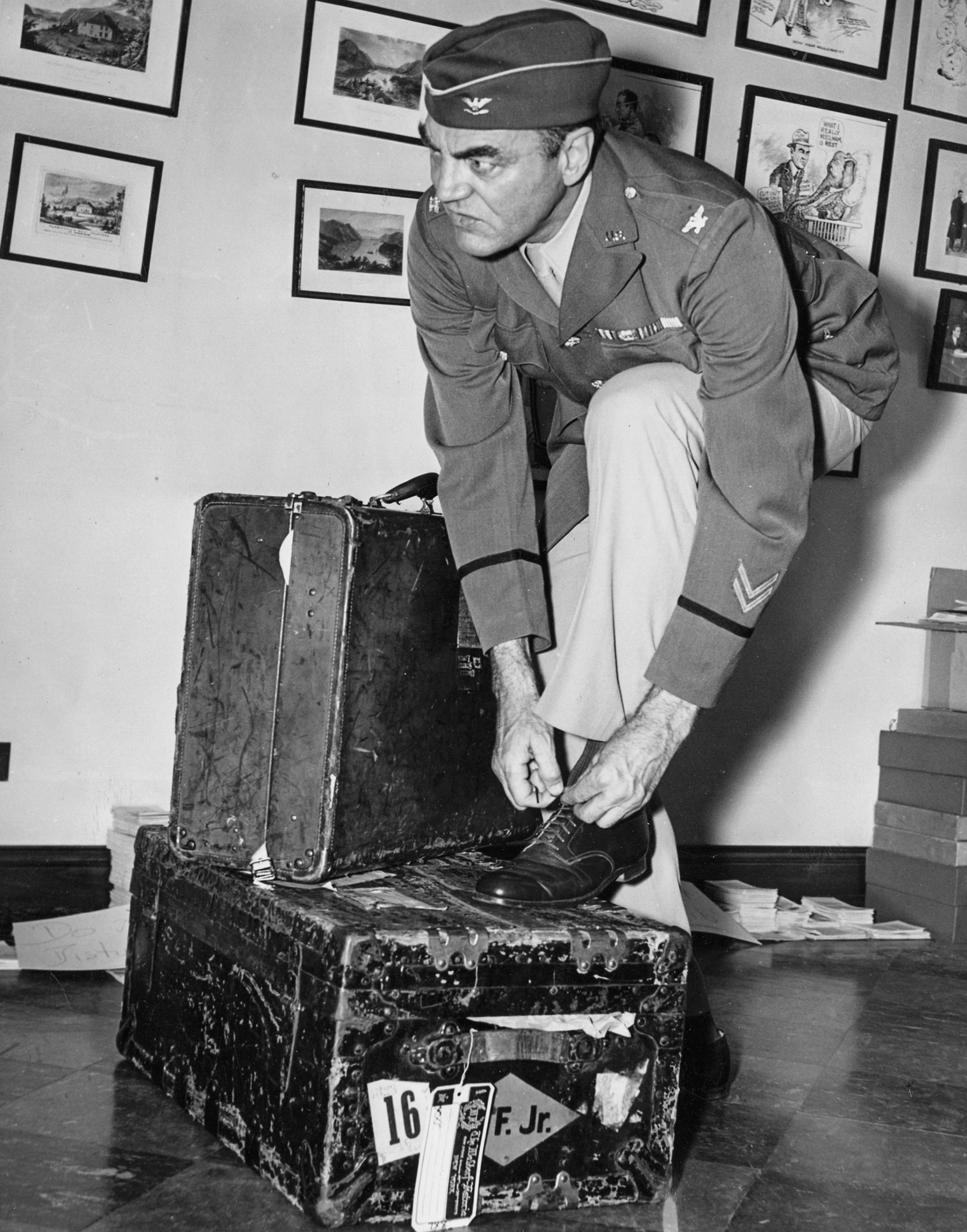
Representative Hamilton Fish heads to army reserve training in 1942.
Headlines were full of war talk in Europe that summer: “Hitler Lays Plans to Cut Up Poland”; “Heavy Troop Movements Reported on Border of Silesia”; “Democracies Gird Their Loins.” Fish told reporters he was heading to Germany on a personal mission to keep the peace. The Nazi foreign minister hosted Fish at his mountain retreat for a one-on-one conference. “We talked over the general situation and how we could establish better relations with the United States,” Joachim von Ribbentrop would say later. “[Fish] was counted on our side as one of the people who would be likely to collaborate with us.”
At the meeting with Ribbentrop, Fish decided not to push too hard on the “refugee question,” as he put it, which was really the eliminationist persecution of the Jews question. “ The European situation is so tense that this might irritate Germany,” Fish explained to reporters. Fish also told the press he was hopeful that tensions over Germany’s designs on Poland could be resolved peacefully, and that Germany’s claims were “just.” The American then accepted a ride in Ribbentrop’s private plane to a convention of European officials in Oslo where he appeared to be carrying water for the German Foreign Office—basically urging the delegates to accommodate Hitler and not fight him.
At the exact same time—just a few weeks before Hitler started World War II by invading Poland—George Sylvester Viereck was in Germany, too. On his own personal mission to solidify his position with the Nazi Foreign Office as its indispensable man in the United States, Viereck had more success on his German trip than Fish did. He departed Berlin with a couple of fat contracts in hand. One was with the state-run Münchner Neueste Nachrichten newspaper, where he would serve as correspondent reporting on the latest developments in America. The other was with the German Library of Information, another Nazi government front, for which Viereck would produce Facts in Review, the digest of world news with a Nazi point of view that would be distributed to influential voices in America who could keep up the pressure to keep the United States out of the war. The contracts were each worth $500 a month to Viereck (about $10,000 in today’s dollars), plus a generous stipend for expenses. The big bonus, though, was that the contracts gave Viereck cover. He was able to work directly for, and in the pay of, the Nazi government while registering at the U.S. State Department as an “author and journalist” in the paid employ of these two “privately-owned” German press services.
Viereck’s real job, of course, was as a Nazi agent blanketing America with a message sharpened largely by Joseph “Propaganda will help us conquer the world” Goebbels but conceived by Hitler himself. The great masses, he wrote in Mein Kampf, “ will more easily fall victims to a great lie than to a small one, since they themselves perhaps also lie sometimes in little things, but would certainly still be too much ashamed of too great lies. Thus, such an untruth will not at all enter their heads, and therefore they will be unable to believe in the possibility of the enormous impudence of the most infamous distortion in others.”
Hitler’s lies spread misinformation that was favorable to Germany and unfavorable to us and our allies, and sowed dissension among the American public not just about the war effort but about our own basic system of government. His very well-funded propaganda mission in the United States was twofold: to try to keep the United States from getting into World War II, and also to soften us up, to mess with us, to make us less effective as a country, by finding and exploiting what the Germans called “kernels of disturbance” in the United States.
The German propaganda operation in America, according to the first U.S. academic study on the topic, identified these kernels of disturbance as “ racial controversies, economic inequalities, petty jealousies in public life,” and “differences of opinion which divide political parties and minority groups.” Even the “frustrated ambitions of discarded politicians.” Germany’s agents were tasked with finding these fissures in American society and then prying them further apart, exploiting them to make Americans hate and suspect each other, and maybe even wish for a new kind of country altogether. A partisan, bickering, demoralized America, the Nazis believed, would be incapable of mounting a successful war effort in Europe. It might even soften us up for an eventual takeover.
Hitler was counting above all on racism and religious bigotry to carry the day in the United States, and to set the stage for global domination. “The wholesome aversion for the Negroes and the colored races in general, including the Jews, the existence of popular justice [lynching]…scholars who have studied immigration and gained an insight, by means of intelligence tests, into the inequality of the races—all these strains are an assurance that the sound elements of the United States will one day awaken as they have awakened in Germany,” Hitler said.
His not-so-secret weapon of choice was plain antisemitism. It was the indispensable first step to global, genocidal, total race war. “ My Jews are a valuable hostage given to me by the democracies. Antisemitic propaganda in all countries is an almost indispensable medium for the extension of our political campaign. You will see how little time we shall need in order to upset the ideas and the criteria of the whole world simply and purely by attacking Judaism…. And, once the principle of race has been established by the exposure of the particular case of the Jews, the rest is easy. It logically follows step-by-step that the existing political and economic order has to be ended and attention paid to the new ideas of biological politics…. We cannot set limits here or there as we please. We shall succeed in making the new political and social order the universal basis of life in the world.”
EVIDENCE OF HITLER’S propaganda operation in America started to spill into public view as early as 1940 because of intrepid diggers like Henry Hoke and Drew Pearson and Dillard Stokes. But the story was told in full, point by point, at George Sylvester Viereck’s criminal trial. Viereck had wasted no time upon his return from Berlin in 1939. His first important stop once back in Washington was at the office of an old friend, Senator Ernest Lundeen. Viereck and Lundeen had a relationship that went back two decades, back to when Viereck was working on behalf of the kaiser to keep America out of World War I and Lundeen was contributing to his German-funded Fatherland magazine. Twenty years later, Lundeen was still decidedly antiwar, decidedly pro-German, and, just as important, decidedly greedy. This was a man who was demanding huge cash kickbacks from his entire Senate staff, after all.
Viereck basically offered Lundeen a deal too sweet to refuse. The senator could keep doing what he was doing already—working hard to keep America out of the war in Europe—but Viereck would arrange for him to make some serious cash while doing so. Taking his propaganda directives from the German Foreign Office, Viereck would write speeches and articles for Lundeen. Under the senator’s name, he would arrange for them to be printed in major American magazines and newspapers. And then Viereck and Lundeen would get paid for it. Viereck was already rich thanks to his multiple German government contracts and front operations, but for the Minnesota senator this was more than just pocket money; it was a whole new serious stream of income.
The two men did it in broad daylight, from inside Lundeen’s Senate office. The Nazi agent, as the senator’s ghostwriter, penned warnings that Americans should not believe “atrocity tales” about the Nazis, and that Germany posed no threat to the democracies of England and France. He wrote that America was being “laughed at for our trouble” even as “mysterious influences [were] at work” to maneuver us into paying for Europe’s war. One of Viereck’s pieces ran in the New York Journal and American newspaper over a stoic three-quarter-profile photo of Senator Lundeen and the senator’s byline: “Democracy and U.S. Can Be Saved, Asserts Lundeen. But Survival Depends on Minding Our Own Business, Says Senator.” Viereck even wrote a “personal” reflection by the senator about his son, Ernest Lundeen Jr., attending a military academy. That one, Viereck explained, was to give the senator cover as an all-American “patriot” while he assailed Roosevelt’s measures to shore up the U.S. military in the event of war. Lundeen was paid—and paid well—for all of it. And once the money was coming in, Viereck made sure to keep him on the hook, telling the senator that he shouldn’t even consider trying to write his own articles, but instead should let Viereck do all of it for him: “ I think in the long run you will find collaboration with me…more profitable both politically and financially than anything that you yourself can do, loaded down as you are with work. I am, after all, right here on the spot. I know the editors and I have some journalistic skill in preparing material in a manner suitable to their needs.”
In 1939, after his return from Berlin, Viereck brought a whole new energy to the collaboration; his propaganda directives were now coming straight from the German Foreign Office. Lundeen’s top Senate staffer, Edward Corneaby, personally witnessed the supercharged Viereck-Lundeen operation in action: He heard and saw Viereck use one of Lundeen’s Senate office phones to call up the German embassy and ask somebody there to send over material ASAP. When the messenger soon arrived from the embassy, Corneaby saw that he bore with him a fully written speech attacking the late British ambassador to the United States. Senator Lundeen then delivered that speech in the Senate and made sure it was entered in full into the Congressional Record.
The staff member who was charged with typing Lundeen’s speeches, Phyllis Posivio, also had a good vantage point on the Viereck-Lundeen scheme. From her desk right across the hall from Lundeen’s personal office, she saw Viereck constantly coming in and out, sweet-talking her and bringing her candy, and going over the texts of the speeches. Viereck clearly was the writer and Lundeen just the mouthpiece. “I’ve tried to phrase this as best I could in the manner in which you speak,” Posivio overheard Viereck say to Lundeen.
The reason Lundeen made sure to enter those speeches—even the article about his son at the military academy—into the Con gressional Record was so the material could be printed in bulk by the U.S. government, at a discount, and then mailed out for free, under Lundeen’s frank, to as many of his constituents as possible.
Your tax dollars at work, busy eroding American strength and resolve.
Viereck dreamed up a way to further boost distribution through the congressional franking privilege. Why limit this to Lundeen’s Minnesota constituents? To get his Nazi-approved material spread farther and wider, he knew he would need a justification for using Congress’s free postage to send out Lundeen’s mailings nationwide. The law forbade a member of Congress to let any outside committee, organization, or association use the franking privilege, but that law had a nice little Sylvester-sized loophole exception: “This provision shall not apply to any committee composed of members of Congress.” In other words, if Viereck created a national “committee” of some kind for Senator Lundeen, well, that would be fine. They could use the committee instead of Lundeen’s Senate office to send their propaganda anywhere.
So Viereck set up the Make Europe Pay War Debts Committee (it would later be known as the Islands for War Debts Committee) with Lundeen as chairman and Senator Robert Rice Reynolds (the original champion of Build a Wall to keep out refugees) as vice-chairman. Prescott Dennett went on the Viereck payroll, which was really the Hitler government payroll, to run War Debts Committee publicity out of his home office on Rhode Island Avenue. They fitted out the office with three telephones, a separate system for summoning messengers, and plenty of open floor space for mailbags. Dennett lived in the apartment with his widowed mother, who was happy to stuff and address envelopes for her boy. As the committee became a high-volume hub for pro-German isolationist propaganda, Mother Dennett even enjoyed fielding the occasional inquiry from a U.S. congressman about how she liked a speech.
A typical item mailed out in the operation was a Viereck-written speech, “Six Men and War,” which charged President Roosevelt and five other administration officials with nefariously and deliberately driving America into a European war for their own self-serving purposes. The speech echoed falsified reports the Nazi government was releasing to the international press in the spring of 1940. Lundeen delivered the speech on the Senate floor, entering it into the Congressional Record. Then Viereck used laundered German funds to pay for the U.S. government to print 125,000 copies at a discounted rate. Then the War Debts Committee and other like organizations mailed them all over America, postage free, under Lundeen’s frank. The outer envelope included a slogan that grew from the long Hitler-Viereck collaboration: “Europe for Europeans; Asia for the Asiatics; America for Americans.”
The “Six Men and War” propaganda operation set off a significant stir here at home. The War Debts Committee honorary chair, Senator Reynolds, called for an immediate investigation into Lundeen’s bombshell claims about Roosevelt’s secret treachery; after all, they sounded a lot like disturbing reports that were starting to appear in the press around the world. Representative Fish suggested a presidential impeachment.
It was working great, and bonus, it was cheap. The Germans were delighted.
“ I think I can report that this propaganda campaign has been carried through with the success we envisaged,” wrote Hans Thomsen, chargé d’affaires at the German embassy in Washington, in a top-secret telegram to Berlin. “These speeches, whose aim is to prevent America’s entry into the war and to ward off all attacks by interventionist politicians, will be printed each time in the official American parliamentary publication, the Congressional Record, by these Senators and Congressmen, and then an edition of 50,000 to 1 million copies will be sent by them to specially chosen persons. In this manner, German influence is not visible to the outside, and, thanks to the privilege of free postage enjoyed by American Congressmen, the cost of this large-scale propaganda can be kept disproportionately low, since, at the very least, mail expenses amounting to many tens of thousands of dollars would be saved.”
Viereck got big eyes once his tiny hive in Mrs. Dennett’s apartment on Rhode Island Avenue started buzzing in the spring of 1940; he was ready to scale this operation. Viereck started negotiating to buy a publishing house, the decidedly Anglo-sounding Flanders Hall, so he could pay elected officials in America to write books and pamphlets, or simply put their names on the books and pamphlets written by himself or Goebbels’s staff in Germany. He also started putting out feelers to other outspoken isolationists, like North Dakota senator Gerald P. Nye, who by then was making hay attacking Hollywood for “ drug[ging] the American people…fill[ing] them with fear that Hitler will come over here and capture them.” No fan of Confessions of a Nazi Spy, that Gerald P. Nye, even without having seen the movie. Viereck approached Senator Nye’s top Senate staffer to inquire about buying some reprints of Nye’s latest screed to send out in a mass mailing. When he asked the aide, Gerald Movius, for six or seven million reprints, Movius thought he must have heard wrong. “My God, Mr. Viereck, do you realize how much that would cost you?” Movius did the math and said $75,000 (about $1.5 million in today’s dollars), even with the steep congressional discount for government printing. “I think perhaps it could be arranged,” Viereck told the secretary.
Movius and his senator boss demurred, but Viereck had Lundeen and plenty of other isolationists in both the House and the Senate who were happy to help. In the House, the most important was the reliable congressman Hamilton Fish. Fish and Viereck had been friends and collaborators for years. Fish had reportedly quashed a subpoena the Dies Committee issued to Viereck back in 1938. Two years later, Fish and his office still stood ready to assist Viereck as needed. “ Representative Fish,” Viereck wrote to Lundeen in July 1940, “told me that the man in his office is absolutely reliable, and that he knows all the tricks of getting work of the type you contemplate done speedily and economically.” That same month, Fish introduced the German agent to his trusted longtime staffer, George Hill, telling him, “Mr. Viereck has some speeches to send out—of Senator Lundeen’s.” The congressman told Hill to send the speeches out to the national mailing list already compiled in their office for Fish’s own committee, the National Committee to Keep America Out of Foreign Wars.
When Fish left Hill and Viereck alone to make a plan, Viereck asked how big this mailing list was. Hill said it was about 100,000 names. Viereck, skeptical, asked to see it. Hill handed over not only that list but also another with about 30,000 additional names. Thrilled, Viereck told Hill to call up Lundeen’s office to get the ball rolling. There was a lot of material they were going to need to print and mail out.
On his way out of the office, Viereck handed Hill two rolled-up bills. Two fifty-dollar bills. Which represented more than two weeks’ pay for Hill. And so, George Hill got right to work. In fact, when Trip 19 crashed in the Virginia foothills less than two months later, George Hill had become so efficient at running Viereck’s propaganda operation out of Hamilton Fish’s congressional office that they barely skipped a beat when they lost Senator Lundeen.
According to a postwar records scrub in Germany by the U.S. Department of Justice, Viereck and his Nazi friends (with help from George Hill) built up mailing lists “containing the names of 650,000 teachers, 157,000 clergymen, 162,000 physicians, 144,000 lawyers, 73,000 dentists, 46,187 of the larger investors, 21,345 newspapers, 15,000 municipal officials, 11,687 millionaires, 11,000 libraries, 7,419 members of state legislatures, 7,000 accountants, 5,500 judges, 4,612 college fraternities and sororities; and…more than forty other lists ranging from breweries to chain butchers.” That’s on top of the 130,000 names Fish’s office started them off with, plus another 30,000 names they gleaned from Who’s Who. All were targets for Viereck’s well-oiled Nazi propaganda operation.
It soon emerged in the press that there was more to the German scheme, including a big lift from the biggest name in American industry. A secretary working out of the Ford Motor Company in New York gathered what she called “ a mammoth mailing list” from the return addresses on fan mail sent to Charles Lindbergh, Representative Hamilton Fish, Senator Rush Holt, Senator Burton Wheeler, and other famed America Firsters. This list was compiled in Ford Motor Company offices by Ford employees working on company time and shipped to a Nazi-funded publication called Scribner’s Commentator, whose editors were pleased to send out whatever material the German Foreign Office and its agents in America sent them. Scribner’s was also happy to augment this list, which ended up at more than 300,000 names and addresses. The German Foreign Office clearly appreciated the effort: a Nazi agent handed over to those editors $39,000 in cash—almost all of it in $20 bills—in four separate hand-to-hand transfers.
By then, too, Viereck’s Nazi-funded Flanders Hall was publishing anti-interventionist, anti-British books by the hundreds of thousands. The German Foreign Office was advancing him $10,000 per title to cover printing, marketing, and payments to the scribes. Among Flanders Hall’s stable of well-paid authors: Senator Rush Holt of West Virginia and Representative Stephen Day of Illinois. Senator Nye of North Dakota also reportedly entertained his own Flanders Hall publishing offer for a book to be called Aggression, though it never came to pass.
The War Debts Committee mailing operation out of Dennett’s home office, meanwhile, was amping up its rhythm all through the back half of 1940 and first half of 1941. George Hill was like a blur in and out of the Government Printing Office with discounted Congressional Record reprint requests from Viereck. And, boy, was he happy to keep up the pace. What German government money didn’t land in the government printing account ended up accruing to Hill’s personal benefit. While more than $12,000 (about $250,000 in today’s funds) passed through Hill’s bank accounts over just a few months in 1940 and 1941, we know Hill sent a minimum of 620,000 separate reprints in franked envelopes to Dennett’s War Debts Committee office. Likely it was many more. This was mail by the ton.
AND SO IT was that Congressman Hamilton Fish was making sure to steer well clear of the jury box in early 1942, when his staffer George Hill finally went on trial in the first week of January. The congressman voiced support for Hill, whom he had known for a quarter century, since the two had served together in World War I. “ George Hill is 100 percent OK,” Fish told reporters, “and I’ll back George Hill to the limit on anything.” Representative Fish made this statement from the safe confines of his office, though; he was not going anywhere near that courthouse, no matter how many times his name came up in Hill’s trial and no matter what means the prosecution came up with to try to get him in to testify.
America was a different country by then. The temper of the nation had changed in a flash on December 7, 1941, when Japan attacked Pearl Harbor. Four days later, in solidarity with his Asian ally, Adolf Hitler declared war on the United States.
There was little patience for German-friendly agitation in the country after that. Homegrown purveyors of pro-Axis propaganda who missed that point put themselves in peril. Like Ellis O. Jones and Robert Noble, who, four days after Pearl Harbor, impeached a wax dummy of President Roosevelt at a rally of about two hundred Americans at an auditorium in Los Angeles. “ The Japanese have a right to Hawaii,” Jones exclaimed. “I would rather be in this war on the side of Germany than on the side of the British.” Noble claimed, “Our country has not been attacked…. Japan has done a good job in the Pacific.” The two were arrested the next day and charged with making “false statements intended to interfere with operations of the United States military and naval forces.” Those charges didn’t stick, but that arrest marked a change in the weather for men like Jones and Noble.
Any Nazi sympathizers, fascists, and antisemites who were capable of “reading the room” started to do so around that time. Lawrence Dennis, for example, still claimed in private (and would continue to do so until the end of his life) that President Roosevelt had secretly welcomed the attack on Pearl Harbor because he believed a war would consolidate his “dictatorial” power. Yes, Dennis may have been a cynic and a deeply committed fascist, but he was also savvy enough to decide, after Pearl Harbor, that it would be unwise to start that pro-fascist, German-financed magazine he had been working on with Philip Johnson.
Johnson, sufficiently worried about his previous and very public pro-Hitler mania, abandoned his own authoritarian fever dream and cloistered himself as a newly apolitical student in Harvard’s architecture program. He quit writing essays and articles for Father Coughlin’s Social Justice, and he cut off his financial support for Joe McWilliams’s violent Christian Mobilizers and similar groups. When the FBI came around to investigate, most of the faculty and fellow students in Cambridge told the agents that Johnson appeared to have turned over a new leaf. One professor who knew Johnson from his undergraduate days a dozen years earlier explained that the young man was simply “a flighty individual with a feeling for adventure.” The professor assured the G-men that despite the fervor of Johnson’s Nazi years the young man must have since matured, telling them that Johnson “does now see the advantage of democracy.”
The vaunted America First Committee did a full U-turn and announced its support for the war against Japan while the U.S. warships in Pearl Harbor were still ablaze. The attack happened on a Sunday. By Thursday, the day Hitler declared war on America, the organization announced it was shuttering for good. “ The period of democratic debate on the issue of entering the war is over; the time for military action is here,” read the official statement. “Therefore, the America First Committee has determined immediately to cease all functions and to dissolve as soon as that can legally be done. And finally, it urges all those who have followed its lead to give their full support to the war effort, until the peace is attained.”
In the middle of all this political undoing and in the rush to a full-scale national mobilization for war, defendant George Hill found himself stuck between a rock and a very hard Fish. Representative Fish kept insisting that he had never had any great feelings for Germany; it’s just that he was against any foreign war. He frankly could do without any public suggestion to the contrary, now that we were at war with Germany, and in an election year, too. What a terrible time for Hill, Fish’s top aide, to feel a new urge to confess everything and tell the truth about the Nazi-run propaganda operation inside Congress. Although Hill had initially pleaded not guilty, he told his defense attorney that he’d had a religiously induced change of heart. “ I was at the communion rail at the Epiphany Church one Sunday when I decided to tell the truth,” Hill later explained. “I then went to my attorney. I told him I was going to the FBI and tell the truth.” Attorney John O’Connor, the former congressman who was essentially working for his friend Hamilton Fish, sized up Hill and said, “You are going nuts.” O’Connor told Hill he best keep his trap shut about George Sylvester Viereck and Ernest Lundeen and Hamilton Fish and the rest. “You would not rat on them, would you?”
He eventually would. But not just yet.
Hill sat mum through his trial, sometimes working nervously at his pipe. His appearance belied his womanizing reputation. Reporters described him as reedy, graying, meek, bespectacled, older-looking than his forty-five years, often wearing the same “shabby brown suit.” Dillard Stokes, who covered the entire franking affair for The Washington Post, wrote that Hill looked “more like a middle-aged professor visiting an angry dean than the German propaganda machine ‘key man.’ ” But whether he looked the part or not, the open-and-shut evidence in Hill’s five-day trial told the tale conclusively.
The proceedings would have been even quicker than five days but for continuous objections and interruptions from O’Connor: his perorations about defendant Hill, “ a poor, little insignificant clerk to Mr. Fish,” and his baseless accusations that the prosecutors William Power Maloney and Edward J. Hickey had planted evidence in the mailbags that Hill had tried to hide from investigators. The entire trial, O’Connor kept reminding the jurors, was an “effort to smear” the great and good representative Hamilton Fish, a patriot and from such a good family, who had worked so hard to keep American boys out of another war. Fish himself, careful to get nowhere near the courtroom, provided backup vocals from the safe zone of his congressional office. “Mr. Hill,” Representative Fish said, “had no use for the Nazis. As a disabled combat veteran, he had an obsession against our involvement in the war.” But that was before Pearl Harbor, of course. Hill and Fish both, naturally, now stood ready to serve.
O’Connor promised to produce a parade of defense witnesses and much exculpatory evidence for his client. He produced exactly none. He offered no defense. Largely because there was none. George Hill, plainly and incontrovertibly, had lied about his acquaintance with George Sylvester Viereck, about trying to hide all those big mailbags from the grand jury, and about his knowledge of the overall congressional Nazi propaganda scheme. Hill was convicted of perjury and sentenced to a minimum of two years in prison. Given a chance to make apologies at his sentencing hearing, Hill simply nodded his head side to side and remained silent.
Still, the prosecutors William Power Maloney and Edward J. Hickey had not given up hope of persuading George Hill to come clean. Maybe his earlier, religiously inspired twinge of conscience had not been enough to get him over the line, but the prosecutors hoped they could still do it; they resolved to keep talking with him. And it worked. Somewhere along the way, Hickey made a comment to Hill that stuck with him. “ The main thing I recall was that Mr. Hickey reminded me I was an American citizen,” Hill explained. “That worked on my mind. And a couple of days later I decided I would tell the truth.” Threats from his own attorney (his boss’s friend) notwithstanding, George Hill agreed to testify at Viereck’s upcoming trial, as did various staff members of the Islands for War Debts Committee, as did most of the office staff of the late senator Ernest Lundeen.
In just four weeks, prosecutors at Viereck’s trial revealed exactly how George Sylvester Viereck wheedled into the heart of American power, into the U.S. Congress, and then persuaded elected officials to sweet-talk their countrymen about all the fine, fine qualities of Nazi Germany that we were overlooking. Viereck’s strategy, as Maloney summed it up, “ was to put words in the mouths of legislators on Capitol Hill who were duped with his clever talk—we don’t know what else—while he laughed at them in secret reports he sent to Berlin.”