CHAPTER FOURTEEN
SMALL WORLD
The role of Christian martyr fit John F. Cassidy like a pontifical glove. Late in life, looking back more than fifty years after the fact, the anointed leader of the Christian Front would insist that he had never truly felt in jeopardy. He put his faith in God and in American patriots and appeared to relish his place in the very public political drama that opened with his arrest on the second Saturday of the year of our Lord 1940. Cassidy got the full glow of the spotlight one day later, when he and sixteen co-defendants were rousted from their holding tanks at the Federal House of Detention at the far end of West Eleventh Street in Manhattan and taken to Brooklyn to be arraigned.
“[ FBI director J. Edgar] Hoover came to New York City to hold a news conference,” Cassidy told a sympathetic reporter from The New York Times in 1995. “You wouldn’t believe the show he staged! One by one, we were led out of the Federal detention headquarters into a car. There were three agents in each car and a motorcycle in front. Multiply that by seventeen defendants! The whole motorcade screaming through downtown Manhattan. And above us, on the West Side Highway, they had a full truck of special agents with machine guns pointing at us. What a lot of nonsense.”
The defendants did not cut particularly dashing figures when they stood to face Judge Grover Moscowitz in the federal courthouse in Brooklyn that day. The lede in The New York Times described the men as “ more frightened than revolutionary.” The lineup of alleged criminals, according to the brief bios lawmen had already passed out to the media, included a chauffeur, a tailor, a postal telegraph clerk, two Brooklyn Edison clerks (one of them John Cassidy), a telephone lineman, a dogsbody for a local department store and another for a local hotel, a baker, a tailor, a high school honor student, an elevator mechanic, and a washing machine salesman.
The New York Times reporter counted about forty G-men in the standing-room-only courtroom that day, and Director Hoover insisted he had a damn good reason to put those defendants under heavy guard, in spite of appearances. The suspects had in their possession at the time of their arrest, according to an itemized list the FBI distributed, fifteen “partly completed” bombs, a significant quantity of cordite and similar explosives, detonators, fuses for dynamite, more than a dozen military-grade rifles (one with a fixed bayonet), a .32 automatic pistol, a 20-gauge shotgun, 4,000 rounds of rifle ammunition and an additional 750 rounds packed into ammo belts to be fed into machine guns, and a long sword. The FBI was still searching other known addresses and safe houses and expected to find more of what Hoover called “a small arsenal.”
The G-men had disrupted only one of the Christian Front’s paramilitary cells as of that moment, and it was hard to know how many more were out there. The FBI was already hunting similar groups in Philadelphia and Boston. “ We expect more arrests,” U.S. Attorney Harold M. Kennedy said. “We have merely scratched the surface.” The FBI believed the number of New Yorkers who had sworn allegiance to the Christian Front was in the thousands, if not the tens of thousands; it was hard to know how many were active in the group’s armed paramilitary wing, but the investigators had reason to believe that number was growing. The numbers, though, were not the most important part of the story. Hoover made sure of that. Remember, he told reporters, “ it took only twenty-three men to overthrow Russia.”
This particular group of New Yorkers had been conducting weapons and tactical training for months, Hoover explained. They had been building bombs with their own hands and stockpiling guns and ammunition. And they were set for imminent action, intent on putting in motion an escalating and cascading armed revolt that would end with the seizure of federal armories and arsenals and then the reins of government itself. “ The club planned among its early acts of terror, beginning sometime after the training period of January 20th, to bring about a complete eradication of all Jews, seize all public utilities, including power, water, railroads, and all forms of communication and transportation,” Hoover said. “The government they proposed setting up, they referred to as ‘a dictatorship similar to Hitler’s.’ ”
In case anybody doubted the seriousness of this case, or what was at stake, Hoover pointed to the raw language of the indictment. The men were being charged with “conspiring to overthrow, put down and destroy by force the Government of the United States, and oppose by force the authority thereof.” In a word, sedition. They were also being charged with a conspiracy “to seize, take and possess property of the United States.” The property in question comprised the explosives, rifles, and bullets the Christian Fronters had already relieved from military armories. Hoover named William Gerald Bishop and John F. Cassidy as the ringleaders of the plot and hinted at the close ties between Cassidy, the Christian Front, and Father Charles Coughlin, the most powerful right-wing media figure in the country.
Father Coughlin’s first instinct was to cover his own Christian rear end, which he did in a public statement as soon as news of the arrests flashed across the nation. He was very quick to deflect evidence of the support, financial and otherwise, that flowed between his ministry and “this so-called” Christian Front. “For some time they have been praising me, holding meetings in my name, and pretending to collect money for my support,” Coughlin said. “I have roundly disavowed them. Moreover, following Oct. 25 of last year, they sent me a check of some $1,000 which I returned to them in a public manner, telling them that I would not accept any such kind of money and advocating my followers to have nothing to do with such organizations.” (This was a lie, as far as anybody could tell, from the man who had in fact been telling his entire listening flock that it was time to organize themselves into Christian Front militia units and that the time was coming to go “Franco’s way.”)
Coughlin’s strenuous disavowal did not last out the week, however, once it became clear that initial public reaction to the dramatic criminal allegations tended toward dismissive. New York City’s mayor, Fiorello La Guardia, reportedly laughed at hearing the news. “ I don’t think the United States government is in much danger from eighteen guys like these,” he told reporters. The Christian Fronters’ plan to bomb the Russophile Cameo Theater was, snarked one wag in The New York Times, “ a classic example of the indirect, or super-subtle, approach to overthrowing a government.” Even one stridently antifascist New York congressman called the Christian Front’s coup plan a “ crackpot conspiracy” dreamed up by “political lunatics.” Reporters scared up civilians who had witnessed the Christian Front target practice and described their marksmanship as “awful.”
“ The great plot to seize America,” wrote Coughlin’s hometown newspaper, the Detroit Free Press, “will go down in the funny books of history to be written about the New Deal long after the headaches of it are over.” One national wire service reported that “public opinion was inclined to dismiss as fantastic the alleged plot.”
The folks who did take the plot seriously often seemed sympathetic to the alleged perpetrators. The defendants played to that audience. Bishop told reporters he was wearing “a crucifix blessed by Father Coughlin” and a medal honoring the patron saint of impossible causes at the time of his arrest. Cassidy was passing time in the holding tank, his defense attorney explained, saying the rosary. The snapshot of would-be American Hitler, William Dudley Pelley, that the G-men had found in his wallet went unmentioned, but Cassidy was not shy about showing off the “symbolic” rifle bullet he carried in his pocket. “I am not guilty of anything but Christian-American self-defense,” he told reporters at the arraignment hearing. “All I can say is—Long live Christ the King! Down with Communism! That’s my message. And get it right.”
“ We are defending ourselves against the encroachments of communism,” the doughy, dull-eyed defendant Macklin Boettger added that day. “No one pays attention to communism—not even the FBI. Look around and see: the Communists are loose and here we are in the pen.”
Coughlin could feel the winds turning in a direction favorable to his now most famous followers, and in his first Sunday radio sermon after the arrest he tacked his vessel to take advantage. “I appear before you today to record the fact that while I do not belong to any unit of the Christian Front, nevertheless, I do not disassociate myself from that movement,” he told nearly thirty million faithful listeners across America. “I reaffirm every word which I have said in advocating its formation; I re-encourage the Christians of America to carry on in the crisis for the preservation of Christianity and Americanism more vigorously than ever, despite this thinly veiled campaign launched by certain publicists and their controllers to vilify both the name and the principles of this pro-American, pro-Christian, anti-Communism and anti-Nazi group.” (This last bit might have been a bit stinging to the actual Nazis who were helping to support Coughlin’s media ministry.)
Coughlin’s decision, he said, was to “stand by” John F. Cassidy and the others through their trials. “Real Christians of this nation will not beat a retreat,” Coughlin insisted. “And why will we not retreat? Because the Christians of America are asking themselves this question: ‘Why did Attorney-General Murphy and Mr. Hoover fail to apprehend the 2,000 or more Communists working in the public buildings at Washington almost under their very eyes—members of an organization foresworn to overturn this Government; foresworn to drag Christ down from His cross, expel Him from our churches, ostracize Him from our schools and public institutions and, according to the pattern of the Spanish loyalists, crucify Him again in the hearts of our citizens?…In our days we have seen Christ scourged from our schools, His principles mocked in our courts…. Despite the garbled statements contained in some newspapers last Monday relative to my position, I take my stand, not retracting one word which I have said either today or on previous occasions relative to the matter of a Christian Front and to the principles which should characterize its membership. Long live Christ the King! God save the Constitution. For those of us who believe in the principles of Christianity there is no retreat; for us there is no white flag of surrender! Long live Christ the King! God save the Constitution!”
An entire flotilla of isolationists, anticommunists, and/or antisemites fell into Coughlin’s rhetorical wake. The Republican governor of Vermont suggested the prosecution of the Christian Fronters was a cynical ploy by the Roosevelt administration to push the country toward war with Germany and “ to teach a lesson to other citizens who feel like criticizing the government.” Representative Jacob Thorkelson, the antisemitic Montana Republican who had acted as cornerman for George Van Horn Moseley during the general’s congressional testimony, and had briefly been endorsed for president by William Dudley Pelley, released a statement on February 2, 1940. The Christian Front had done nothing more than take some target practice, the congressman wrote, and the entire case was a “ childish attempt to shield the Communists.”
Two days later, the defense lawyer hired by Cassidy and eight other defendants headlined a rally for the “Brooklyn Boys” in a local arena. “This is a fight for Christ!” the attorney hollered. “I don’t have to apologize to anyone for being a Christian!”
THE ROOSEVELT ADMINISTRATION was making no apologies either. When Robert Jackson took over as U.S. attorney general three days after the arraignment of the Christian Front, he found a memo from President Franklin Delano Roosevelt waiting on his desk. The swift and successful investigation and prosecution of “Cassidy & Co” was to be among the Department of Justice’s priorities. Jackson scrambled the newly appointed head of the DOJ’s criminal division, O. John Rogge, to Brooklyn to oversee the high-profile but knotty case.
A conviction on seditious conspiracy was a tall order, and everybody knew that. Hoover had said as much to his closest assistant—even before he went in front of any cameras to point a finger at the Christian Front plotters. The director could not shake the memory of a case from a generation earlier, when he was a twenty-five-year-old kid lawyer doing his first tour of duty in the attorney general’s office. After a bunch of anarchists had been charged with sedition in Buffalo, New York, in 1920, a federal court had tossed out their case and lectured DOJ that the seditious conspiracy statute applied only when there was “an overt act.” So Hoover understood that evidence of conspirators taking target practice at Roosevelt dummies and bragging about “overthrowing the government” in the bar of a rustic lodge on the Delaware River was probably not going to cut it, no matter what else they were planning.
A conviction was much more likely on the charge of theft of government property, considering the amount of firepower the Fronters had purloined from U.S. stocks. And on that one, the evidence gathered at the time of the arrest and in the days after seemed unassailable. In the house shared by the National Guardsman Claus Gunther Ernecke and Macklin Boettger, the FBI seized 1,070 rounds of rifle ammunition, seven cans of cordite, and detonating fuses. Bishop’s house held more than 400 rounds of machine gun ammunition packed for rapid fire.
The biggest cache was at a house in the Stuyvesant Heights section of Brooklyn, where the Christian Fronter John Albert Viebrock lived with his parents. There was one rifle standing by the coat tree at the entrance of the attached three-story dwelling, but the basement was the mother lode. The G-men found a loaded-up machine gun belt hidden away in one cabinet, and eleven containers, each holding twelve silk rings of cordite in a fireless cooker. “Next, the fireless cooker yielded a coffee can that held thirty-four more rings of cordite and then came four green shells,” according to news reports of the testimony of an FBI special agent who cataloged the ammunition and appurtenances. “A container that had held these shells was on a workbench nearby…. On the workbench was a piece of paper that Viebrock admitted was a sketch of a bomb drawn by Bishop for his guidance. There was also an envelope containing specifications of three different types of bombs that Viebrock said he was making…. The agent identified one after another, twelve soup cans and eight beer cans that he said were being made into bombs. He explained that a smaller can was soldered into a larger can, a tin tube was inserted into a larger can, a tin tube was inserted into the inner can to permit introduction of an explosive charge and a fuse, and then the space between the two cans were filled with plaster of paris.”
The G-man, one reporter continued, “found a section of pipe about eighteen inches long upright in a vise at the workbench and that Viebrock had said he was making a bomb out of it. He also identified five sections of brass pipe which Viebrock told him were destined for the same purpose.”
The FBI found very little of the Christian Front’s stockpiled arsenal in John F. Cassidy’s own house, but they did take possession of private jottings and correspondence from the desk of the Little Führer. One of Cassidy’s notes to self spoke of plans for a vast expansion of their ammo cache—“30,000 rounds Camp Dix.” More worrying was the telegram suggesting that Bishop had got his hands on U.S. Army machine guns. “It’s raining today, but the Browning Light Machine guns are rattling on the range,” Bishop had written to Cassidy from a training session in the mountains of West Virginia. “A few of the boys, group commanders, asked me to send you and your men greetings from them for Christ and country.”
Nevertheless, even the weapons charge soon got wobbly. If the Fronters had gained possession of U.S. military machine guns, that was illegal—no question. FBI investigators thought they had a line on the real story when they learned that two Browning Automatic Rifles—machine guns—had in fact been stolen from a National Guard armory in Waltham, Massachusetts, the previous September, right around the time the Christian Front was recruiting Denis Healy as their “future machine gunner.”
When FBI agents showed up in Waltham to trace the stolen guns, though, the trail ran cold. “ There was a cover-up in the National Guard because the sergeant at arms who should have been responsible for these weapons refused to talk to the FBI about their final disposition,” says Charles Gallagher, the first person to see the FBI files on the case, seven decades after the fact. “His superior officer also declined to talk to the FBI about this case. And because the commanding officer [of the local National Guard in Waltham] didn’t want to have his sergeant prosecuted, they just shut up. Everybody clammed up.” If the U.S. military did not want to admit that its weapons had in fact been stolen, then as a criminal matter it was going to be hard to prosecute the theft.
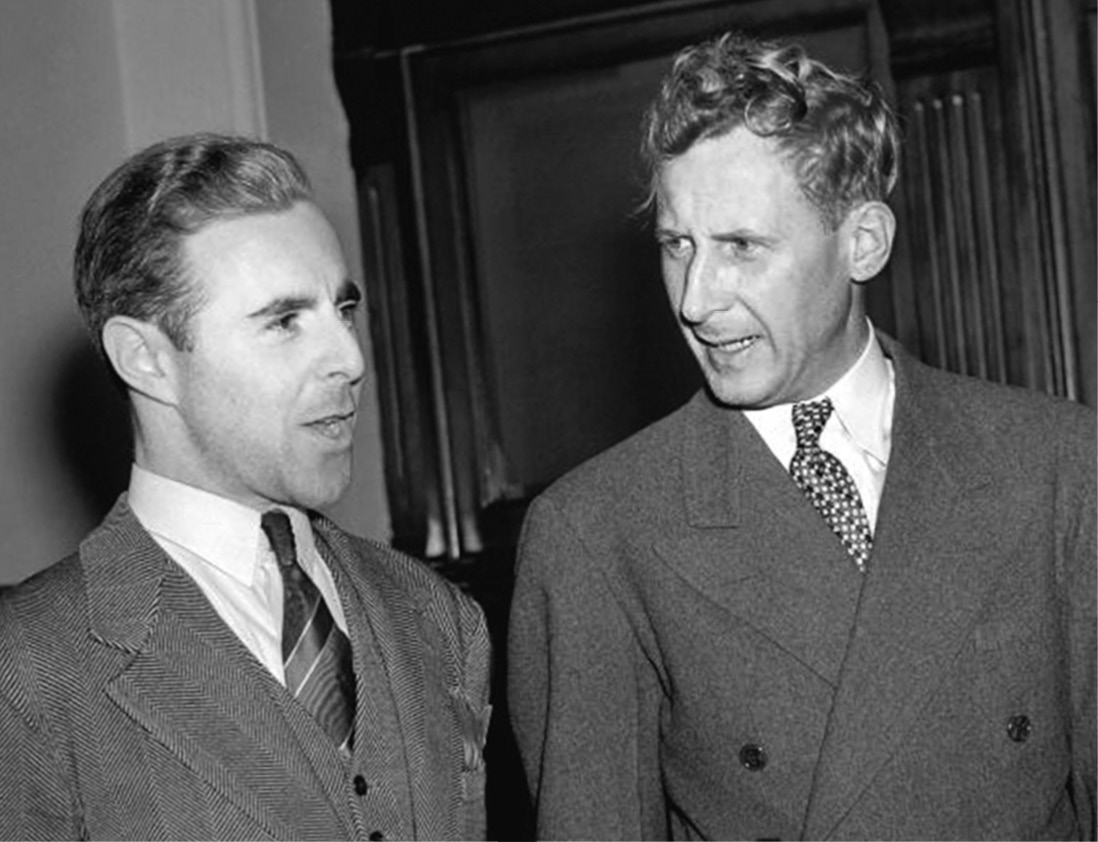
John Cassidy (left) with William Bishop (right) at the Christian Front trial in Brooklyn
By the time the Christian Front trial commenced at the beginning of April 1940, the U.S. marshal in Brooklyn knew to keep backup deputies on alert near the courtroom. Even preliminary bail hearings had drawn as many as five hundred New Yorkers, many of whom had a hard time holding their tongues. A few yelled insults at the defendants, but most were there to show their support. “ This is a hell of a country!” they shouted. “Down with the Reds!…Long Live Christ the King!” The marshals had to rush in to hold back the crowd, which at one point, according to one newspaper reporter, “ surged toward the defendants.” The national headline the next day was “Christian Front Men Deny Guilt amid Uproar.”
The judge understood emotions were running high, and he meant to limit the opportunity for mayhem. So, for the entire trial, no visitor was permitted into the courtroom without a special pass issued by the marshal; in fact, nobody was even permitted on the same floor of the courtroom while trial was in session unless they could prove they had business there. This did not fully calm the circus atmosphere in the opening days—the deputies still had physical scrapes with would-be spectators trying to force their way in—but it did shunt most of the madness outside. One newspaper reporter who ambled out of the courthouse during the first noon recess witnessed a heated argument about the trial turn into a bare-knuckle boxing match. Meanwhile, four enterprising Coughlinites were selling the latest issue of Social Justice on the courthouse grounds (a target-rich environment), and a young woman was screaming, on a constant loop, “The same gang that crucified Christ are at it again, trying to convict these seventeen innocent Christian boys.” One mounted policeman, the reporter wrote of the scene, “cautioned her not to start trouble, but after he disappeared she continued her cries.”
Even the normally placid process of voir dire devolved into a “blistering examination” of the would-be jurors. It was two full days of prodding them about their reading habits, their political affiliations, and their feelings toward Jews, antisemites, Catholics, Irishmen, and communists. One defense attorney claimed to the judge—and every reporter and every potential juror—that prosecutors were trying to stack the deck with an all-Protestant jury. This was not true, but it was a nice way to imply (falsely) that prosecutors were prejudiced against Catholics and needed to be watched. The defense, meanwhile, proved enthusiastic and adept at knocking off the jury anybody who had a whiff of commie to them, even tossing a Works Progress Administration employee because his paycheck came from the federal government—which, after all, was the party bringing the case. The woman finally selected to be foreperson of the jury was a middle-aged Brooklyn housewife who told the attorneys this was her first time ever in a courtroom. The prosecutors, alas, had failed to ascertain that she was related by marriage to the lead defense attorney in the case.
The Brooklyn U.S. Attorney, Harold M. Kennedy, argued the case at trial, but every day in court O. John Rogge, the chief of the criminal division from Main Justice in Washington, was there at the request of his boss, Attorney General Robert Jackson, who in turn had been prodded by his boss, President Roosevelt. “ He is kind of tasked with being the executive chess player behind how the government’s case is going to be argued,” says Gallagher. “Many in the government are critical of Rogge’s choice because they feel he does not understand the cultural position on the ground.” Rogge “doesn’t understand Brooklyn Catholic culture. And he doesn’t understand the jury, which is going to be composed of Brooklynites. Rogge is from southern Illinois, and he went to Harvard Law School, and he has no perception that the jury pool is going to lean in certain directions. His legal team was composed of lawyers who were equally deficient in understanding the culture that they were moving in. Brooklyn in the 1930s was deeply…informed by Roman Catholicism in their anticommunism and…kind of an endemic style of antisemitism.”
THE FBI INFORMANT Denis Healy was the crucial witness for the prosecution. At the top of the trial, he spent more than six full days on the stand as the U.S. Attorney led him through his brief career as a mole inside the Christian Front. Healy had at hand a tattered, five-cent, mauve-colored notebook he had used to memorialize conversations from the various dinners and meetings he attended with his fellow Fronters and National Guardsmen. Thanks to the detectaphone system they had installed, FBI special agents had been able to listen in and make contemporaneous notes on any meetings held at Healy’s dinner table or in his basement. But it was up to Healy himself to record the minutes of the many secret gatherings held elsewhere. Healy, who had little formal schooling and had largely taught himself to read and write, would spend hours after each meeting painstakingly scratching out his notes on the secret conversations.
In the witness box, referring to his notes, Healy spelled out the recipe of the Christian Front’s increasingly violent concoction. He detailed the fanatical antisemitism that united the group; the structure of the paramilitary Sports Club/Country Gentlemen; the stolen weapons and ammunition they stockpiled with the help of National Guard officers and NCOs at a local armory; the classes in bomb making; the discussion about and selection of targets, including the intent to “knock off” twelve congressmen who had voted to permit the United States to help arm the Brits and the French in their new war with Germany. He had it all, right there in those notebooks.
The cross-examination was withering. The defense attorneys painted the FBI informant as a fabulist, a liar, and an agent provocateur who loosened the tongues of these good Catholic boys with government-provided liquor and pheasant dinners. And then, they said, he enticed them into antisemitic rants and an increasingly militant commie-killing plot that was actually dreamed up by Healy himself and the FBI to entrap the Country Gentlemen. Denis Healy, the defense attorneys asserted, was more than disloyal to his friends. He was a snitch. Which was the worst thing you could be in the prevailing working-class, Irish Catholic culture in Brooklyn. He was worse than the worst, the defense attorneys claimed. He was a paid snitch, having accepted a weekly stipend from the FBI.
Five days into his testimony, with the defense’s inquisitors hammering at him, Healy collapsed and had to be taken to the hospital, delaying the testimony until the next day. The trial was delayed again the next day by the disappearance of the defendant Claus Ernecke, the man who had invited Healy into the Christian Front in the first place. Ernecke’s defense attorney insisted in court that his client had not skipped bail but had likely been kidnapped and murdered. Probably by commies. Ernecke was indeed found dead in the cellar of a Brooklyn apartment the following day, but not murdered. He hanged himself. Christian Front partisans blamed Ernecke’s demise on government-led persecution.
When Denis Healy returned to the witness stand after a brief stay in the hospital, things got no easier. He admitted that he had provided booze to his fellow Fronters; he had not actually seen the thousands of rounds of ammo Bishop had bragged about; and yes, he had accepted money from the government for his undercover work. Healy was also badly impeached by the mystery of his own personal history. Which seemed to be a mystery to even Healy himself. He couldn’t keep straight the dates of his marriage, or what he had written in his voter registration form. He didn’t know exactly where he was born. “Somewhere in the British Empire,” he finally said. He was unsure whether his father’s legal name was Donald Thomas Healy or Thomas Donald Healy, but he was pretty sure his father had been a spy for the British government. And had infiltrated militant Irish Catholic revolutionary groups. (It was going to be fun going home to the old Irish Catholic Brooklyn neighborhood after testifying to that.) There was a Denis Healy who was also a former member of the British armed forces and wanted by the police overseas, but that was definitely a different Denis Healy, Healy explained, since he was pretty sure the guy wanted by the police was a Denis Healy who had only one eye. And he, Denis Healy, happily had two.
As the Healy testimony went south, special agents of the FBI appeared to save the day for the prosecution. However lax they had been in investigating Hitlerite fascist organizations in America to that point, the leadership at the FBI and its agents on the ground had built an impressive case against the Christian Front defendants. A parade of FBI men testified in open court over the next few weeks. Peter Wacks, described by one newspaper reporter as “a clean-cut, youthful-looking special agent,” was the first in the witness box. The reporter was also impressed with “the crisp, concise fashion [with which] he corroborated large sections of the story that had been told by Denis Healy.” Wacks had spent many hours in Healy’s sometimes-overheated and sometimes-frigid attic, frantically taking notes of the conversations he eavesdropped on. He was also among the agents hiding in the woods in Narrowsburg, New York, filming Cassidy, Bishop, and six other defendants performing target practice and military exercises. The FBI entered that footage into evidence, over the screaming objection of the defense.
Wacks was able to provide verbatim quotations from his notes, to be entered into the trial record. William Bishop had instructed his men to “contact all gripers and growlers in the National Guard” to recruit them for the Christian Front’s mission, Wacks testified. Macklin Boettger bragged that he could blow up a communist-run newspaper and get away with it. Boettger also told Healy and others that he was on the lookout for a rifle with telescopic sights so he could “shoot a few of the key men of the Communist Party.”
The agents traced much of the ammunition they discovered right back to the 165th Infantry Regiment armory in New York City, where a Captain John T. Prout Jr. had instructed his supply sergeant to provide Bishop with ammo for bolt-action rifles and machine guns, as well as rings of cordite. Special agent Arthur M. Thurston dumped onto the desk of the court clerk cartons full of machine gun ammunition, bombs jerry-rigged out of soup cans, beer cans, and brass pipes, silks of cordite, miners’ fuses, and sheets of paper filled with bomb-making instructions. These were all entered into evidence while Thurston, “a husky, dark-haired man who testified with ready self-assurance,” narrated his experience at John Viebrock’s basement workbench. Everybody with an official U.S. marshal courtroom pass was then treated to a screening of FBI film footage taken in that basement following the initial arrests. The scenes, wrote a slightly stunned reporter from The New York Times, “ showed Viebrock smilingly pointing at bombs he had been constructing, while in the background an FBI agent was carrying on the search of the cellar.”
Viebrock, who clearly felt he had little to fear, had been exceedingly loquacious in the days after his arrest, bragging that he was capable of constructing bombs that would be much more lethal than those found in his basement. He also explained to Agent Wacks that right up until their arrests the Fronters were discussing new ways “to incite the Jews and Communists to riot” so good Christians could “then step in and take over the government.”
“ I asked [Viebrock] what he thought of the whole situation,” Wacks testified, “and he replied, ‘I’d do the same thing again.’ ”
This was about the time a Christian Front partisan and local priest in Queens made a not-so-subtle comparison, during one of his Sunday homilies, between the crucifixion of Christ and the prosecution (read persecution) of the Brooklyn Boys. “During the entire legal process” of Jesus Christ’s civil trial and execution, Father Edward Brophy claimed, “every detail was in complete and continuous control of the Jews.”
THE TRIAL WENT on for ten uninterrupted weeks. The other concurrent happening in those ten weeks was Adolf Hitler’s military blitz across western Europe. On April 9, five days after the Christian Front sedition trial opened, Hitler’s army invaded Denmark and Norway. Denmark fell in a day; Norway held out a little longer, but fell just as hard. Four weeks later, German paratroopers, tankers, infantrymen, and airmen roared into Belgium, Luxembourg, and the Netherlands. Americans woke every day for the next three weeks to a map of Europe being rewritten by the sheer pitiless force of Hitler’s Wehrmacht, which appeared unstoppable.
By the last week in May, 200,000 British troops and 140,000 French, Dutch, and Belgian troops were bravely clinging to the last little bit of safe soil, on the far northwest coast of France. “ The British Expeditionary Force means to die where it stands rather than let the Germans occupy the coast where they could base an attack on the British Isles,” wrote an American correspondent for the Associated Press. “Still they were saying today, as I left, ‘let’s have a crack at that goddamned Hitler.’ ”
Five days later, the British were beating a hasty retreat across the English Channel. The evacuation of the French port of Dunkirk would go down in history as the military operation that saved the British Expeditionary Force to fight another day. But not much glory attached itself to the proceedings at the time. The Allied forces abandoned almost all their artillery, tanks, and ammo caches to the approaching German army. By the first days of June, Denmark, Norway, Belgium, Luxembourg, the Netherlands, and much of France had surrendered to German rule. Hitler’s army was beginning its final push into Paris. Germany’s control of the recently surrendered channel ports along the French coast left England more vulnerable than ever. On May 29, the headline in The Washington Post read “Is Invasion of Great Britain Hitler’s Present Objective?” Well, yeah.
The fight to save democracy in the world was on. But by huge margins, most Americans were still hoping someone else would handle it. “ Sentiment for going to war with Germany has increased since the Nazi invasion,” Dr. George Gallup, the nation’s best-known pollster, wrote while British warships were still ferrying retreating Allied troops off the Continent, “but the increase has been less than four percent. A nation-wide survey just completed finds the country still more than 13 to 1 against American entrance into the conflict.”
Macklin Boettger, defendant in the ongoing Christian Front sedition trial, agreed. While testifying in his own defense, Boettger explained that he would be taking a pass on fighting the Germans in Europe even if the United States entered the war. He had no beef with the German government, just as long as it kept its army out of America. When asked by prosecutors if he had ever expressed sympathy for Hitler, Boettger refused to answer. He testified that he was not antisemitic but that he “might have” said that Father Coughlin’s Social Justice was “the only [media outlet] in the country not controlled by Jews.”
The defense made a rousing final argument for the acquittal of John F. Cassidy and his co-defendants. Unlike Rogge and the rest of the DOJ prosecution team, the defense knew their audience, and they tailored their closing plea to that audience, even stipulating some of the ugliest charges. Sure, defense counsel admitted, Macklin Boettger had some antisemitic literature in his home, but he also had copies of the U.S. Constitution. Which he was trying to protect! From communists! “Macklin Boettger says, ‘I’d like to have a rifle with a telescope sight and go out and shoot a few Communists,’ ” the lead defense lawyer explained to the jury. “So would I, and so would a lot of other Americans. I’d like to see them all strung up by the neck.
“But because you’d like to do something doesn’t mean that you’re going to do it. I’d like to see [the Brooklyn Dodger outfielder] Joe Medwick hit a home run tomorrow night, but that doesn’t mean he’s going to do it.”
The jury hung. They were unable to reach a verdict on Macklin Boettger, John Viebrock, William Bishop, or Captain Prout. The bloodied DOJ decided not to get back in the ring and pursue another trial against them, so those four walked. The other defendants, including John F. Cassidy, were then flat-out acquitted.
When the verdict was announced on June 24, 1940—not a single guilty verdict against any one of the defendants—three hundred people who had pushed into the courthouse corridors erupted in cheers. Cassidy walked right up to the judge and demanded the return of all the guns.
Father Coughlin released a statement that next day. “ The so-called conspiracy,” he said, “turned out to be a hoax.” He called the prosecution “ridiculous from the outset, insofar as the government agents seized Gettysburg rifles, heirloom bayonets, and soup tin cans.” He neglected to mention bombs, cordite explosives, or thousands of rounds ready to be fed into stolen military machine guns. And after his followers were swung at and missed, Coughlin explained, we shouldn’t be surprised if the Jews were really gonna get it now. “Regretfully,” Father Coughlin said, “the resentment on the part of the victims is liable to increase the wave of antisemitism throughout the country, particularly now that the jury has found them not guilty.”
Coughlin’s closest ally in Brooklyn, Father Edward Lodge Curran, wrote to Attorney General Robert Jackson to demand that he investigate the investigators. At bottom, Curran was sure, there was a communist plot inside the Justice Department to destroy these Brooklyn Boys, these good and decent Christian patriots who were just trying to uphold constitutional principles.
A few days after the acquittal Curran’s colleague Father Edward Brophy—sometimes called the philosopher of the Christian Front—spoke at a rally of two thousand people in honor of the defendants. Brophy did not return that day to his favorite Jews-killed-Jesus harangue, but he did use some of his time at the lectern to celebrate what you might call Brooklyn’s community spirit. “ There is one matter connected to the jury in this case that hasn’t been disclosed up to this moment, but I think it’s safe to tell you now. I refer to Mrs. Helen Titus, foreman of the jury.” Did he divulge that Mrs. Titus was related to the defendants’ lead defense counsel? No. “You may be interested to know,” he said, “that she is my first cousin.” Huh. Small world.
Brophy went on to shower encomiums on the exonerated suspects. America was founded as a Christian country and remained a Christian country to this day, the priest said, because of “genuine, patriotic citizens” like these men.
The audience roared its approval when John F. Cassidy and seven other defendants were called up by name. Macklin Boettger was invited to say a few words, and he let the audience in on another little courtroom secret. “ At least ten members of our jury,” Boettger told the cheering crowd, “are going to apply for membership in the Christian Front.”