CHAPTER NINE
“PROBABLY TEN TIMES MORE”
George Deatherage’s heart might have skipped a beat when he sighted the flag flapping high atop Embassy Row, in northwest Washington, D.C., on a cool day in February 1939. The flag had been adopted officially less than four years earlier but was already among the most recognized national symbols in the world. The banner sported a bold red background as a field, with a white circle at its center, and inside that circle, in black, a swastika. “ As it brought Germany out of the depths of despair,” Deatherage had recently exclaimed to a small, rabid audience of Americans, “so it will bring the United States.”
As Deatherage neared the ostentatiously turreted, redbrick German embassy, he entered a Nazi safe space, owing more to American diplomatic imperatives than to German security precautions. The U.S. Congress had recently, by legislation, cordoned off discrete protest-free zones—each with a radius of five hundred feet—where it was unlawful to wave signs or placards or the like “designed or adapted to intimidate, coerce, bring into public odium any foreign government, party, or organization, or to bring into public disrepute its political, social, or economic acts or views, or to intimidate, coerce, harass, or bring into public disrepute any diplomatic or consular representatives, or to congregate…and refuse to disperse after being ordered to do so.” The new law, inserted into the municipal codes of the District of Columbia, protected every foreign embassy and consulate in Washington. But it’s not like Americans were frequently enraged enough to go protest on the diplomatic doorstep of the Swiss or the Ecuadorians. The impetus for the law had plainly been the simmering American feelings about the Nazis who were now in charge of the German delegation. In the late 1930s, though, those feelings were still at only a low boil in the United States.
The Nazi annexation of Austria drew twenty-five thousand demonstrators in London in March 1938 but did not spawn major protests in Washington; neither did Hitler’s annexation of the Sudetenland in Czechoslovakia six months later. The true test came several weeks later, in November 1938, when a Polish teenager, Herschel Grynszpan—“an anemic-looking boy with brooding black eyes”—decided enough was enough. “Herschel read the newspapers and all that he could read filled him with dark anxiety and wild despair,” explained Dorothy Thompson, the famous American reporter, who had been closely following the German threat in Europe. “He read how men, women and children…had been forced to cross the border into Czechoslovakia on their hands and knees and then ordered out of that dismembered country, that, shorn of her richest lands and factories, did not know how to feed the mouths that were left. He read that Jewish children had been stood on platforms in front of a class of German children and had had their features pointed to and described by the teacher as marks of a criminal race.” The teenager walked into the German embassy in Paris and shot dead the third secretary.
Young Herschel was thrown into jail to await trial. A postcard he had written to his parents was confiscated. “May God forgive me,” it said. “I must protest so that the whole world hears.” The Nazis used Herschel Grynszpan’s crime in Paris as justification to put the match to a fuse they had been very eager to light. On the night that German diplomat expired in Paris, November 9, 1938, mobs of marauders in Germany, Austria, and the German-occupied Sudetenland—some official police and military, some not—laid waste to families, communities, businesses, and institutions simply because they were Jewish.
News of Kristallnacht (the Night of the Broken Glass) flashed around the globe: the German gangs had burned or dynamited synagogues by the dozens, looted or destroyed Jewish businesses, confiscated millions of dollars’ worth of assets—cash, securities, personal property, art, even furniture and toys. Germans murdered hundreds of Jews that night, beat and raped others. “ Extensive demonstrations,” Goebbels called the vicious attacks; he refused to ask for calm for twelve long hours, by which time the mobs had exhausted themselves. Goebbels blamed the Jews for inciting this atrocity against themselves, then announced that he would levy a fine against the German Jewish community at large— an astounding $400 million—to cover the damages.
Even after news of that harrowing night made front-page headlines in the United States, the area around the German embassy in Scott Circle in Washington, D.C., remained relatively calm. Fewer than a hundred members of the League for Peace and Democracy showed up to raise their placards and their voices at the embassy the next day, and the entirety of their sixty-minute demonstration unfolded at a safe distance, behind chalk-marked lines five hundred feet from the four-story building proudly displaying its swastika flag.
The protesters abandoned their plan to fly kites with anti-Nazi slogans when the local police explained that that, too, was illegal within the District of Columbia and would cost them $10 for every offending kite they flew. The earthbound placards noted by local reporters seemed both deeply correct and also feeble in the face of the terror and devastation the Nazis had visited on hundreds of thousands of innocent human beings in a single night: “Resist Fascist Terror,” “Boycott German Goods,” “Lift the Arms Embargo,” “Appease Fascism? Why Not Tickle Tigers?”
ON A QUIET day three months later, George Deatherage stepped over those faded chalky markings five hundred feet from the German embassy and into the safe zone. The forty-five-year-old sometime construction engineer and full-time political activist was six feet, four inches tall and a solid 205 pounds, impressive girth for an American man in the days before high-fructose corn syrup. Deatherage was combative by nature and girded by a thoroughgoing certainty in his cause, a faith in both the correctness of his views and the urgency of his mission. He saw himself a red-blooded, real-American patriot, a dedicated Christian, a fierce protector of (white) Western civilization. He had looked around, studied and researched the situation for himself, and here’s how it looked in his benighted view: the commies were on the march everywhere, not least in his own country; they had already begun to pollute all that was great and good about the United States. And the Jews were behind all of it.
Something had to be done, now, was how Deatherage saw it. Before it was too late. That’s why he showed no hesitation in waltzing up to the German embassy without appointment or letter of introduction, but with the expectation that he would get an audience. “ We are all brothers in race and culture, devoting our lives to a common cause,” Deatherage had recently written in a Nazi-owned international news service, “a cause which ultimately must mean the salvation of the world for Christian and Aryan people.”
Deatherage’s arrival—he proudly announced himself as the person “raising all this hell around the United States”—presented a bit of a problem at the embassy, a problem that struck at a philosophical and ideological conflict that split its staff right down the middle in 1939. German officials in the United States knew all about George Deatherage; just as they’d been tracking fascist public intellectuals like Lawrence Dennis, the Nazis had been tracking ultra-right American activists like Deatherage for years. When a political agent of the Third Reich in the United States submitted a report to Hitler himself in the summer of 1937—“Achieving Collaboration of Germans with the National Men of America on Behalf of Both Countries”—he singled out James True, the wildly antisemitic Pennsylvania Republican congressman Louis T. McFadden, Father Charles Coughlin, William Dudley Pelley, and George Deatherage. The fascist publications this group spewed every week (“You can help save America, yourself and your family from the folly of other nations by making the truth known to your friends”) were seen by the Nazis as helpful to their cause. There was already an effort afoot in Berlin to help widen their distribution. The author of the “Achieving Collaboration” report even boasted of having introduced Deatherage to Manfred von Killinger, the very aggressive German consul in San Francisco. ( Von Killinger had been in the loop on the planned mass murder of prominent Jews contemplated by Henry Allen and his cohort in Los Angeles.)
But many in the German embassy in Washington wanted to steer clear of the rogue Americans altogether. These were long-serving professionals of their country’s Foreign Office, schooled in diplomatic subtleties. They did not necessarily share in the enthusiasm for the führer’s full program, but it was their sworn duty to give Adolf Hitler the chance to realize whatever destiny he had dreamed up for himself and the fatherland. This meant, on a practical level in early 1939, doing all they could to keep the United States out of the growing conflict in Europe. The führer was setting in motion the war machine he had been building for almost a decade and was confident the German military could roll over shoddily armed western Europe and Britain without much trouble—at least as long as the Americans remained on the sidelines.
And—helpfully for the Germans—lots of Americans wanted to remain on the sidelines. Memories of World War I were still fresh. Both the Democratic and the Republican party platforms in 1940 pledged determination to keep America off the battlefields in Europe. Roosevelt ran for reelection that year insisting that neither our aid to our allies nor our preparations in case of war should be seen as any indication that we planned to jump in, unless we were truly forced to.
In Congress, too, there were the mainstream isolationists, but also senators like North Carolina’s Robert Rice Reynolds, who had just that week granted an interview to Hitler’s mouthpiece newspaper, Völkischer Beobachter, headlined “Advice to Roosevelt: Stick to Your Knitting.” A sample of Reynolds’s reasoning: “ I can see no reason why the youth of this country should be uniformed to save the so-called democracies of Europe—imperialistic Britain and communistic France…. I am glad to be able to state that I am absolutely against the United States waging war for the purpose of protecting the Jews anywhere in the world.”
Among the most outspoken isolationists was the powerful New York congressman Hamilton Fish, who was already heading up the National Committee to Keep America Out of Foreign Wars. Just a few days after the Nazis strong-armed the rest of Europe into the give-us-Sudetenland-for-peace pact, for instance, Fish kept his date as the main speaker at the German Day celebration in New York City, where a few stray swastikas dotted the room and plenty of people in the crowd of seven thousand gave the Nazi salute. Fish, the ranking Republican on the House Foreign Affairs Committee, had avoided any criticism of Hitler in his speech, using the platform instead to ridicule President Franklin Delano Roosevelt.
For the all-important 1940 U.S. election, the German Foreign Office would certainly not be remaining neutral. Its agents were working within the halls of Congress and beyond to help install a more pliable man than Roosevelt in the office of the American presidency. But this kind of work required delicacy, the German diplomatic professionals knew. That’s why the old hands in the Foreign Office, heeding the counsel of American advisers like Lawrence Dennis, had little use for loud, militant, and unapologetic antisemites like George Deatherage. He seemed a cinch to antagonize the very people the Germans most needed to convince of the blessings of neutrality: the middle-of-the-road Americans who were skeptical of expending blood and treasure on a war an ocean away.
There was another faction within the German embassy, however, much more sanguine about Deatherage and scores of other vocal proto-fascists raising hell in America. These younger, more radical players at the German embassy were all in on Hitler’s messianic vision. This embassy faction was made up of men and women who were not foreign service experts but enthusiastic Nazis who had risen through the ranks of the Nazi Party’s in-house Propaganda Ministry on the basis of zealotry. Their godhead, Joseph Goebbels, had begun sprinkling consulates and embassies around the globe with this new cohort.
These Volk read the führer’s book-length political treatise, Mein Kampf, not as bombast, bile, and political humbug but as Holy Scripture—commandments from a modern prophet. By their lights, Adolf Hitler’s ambit could not be restricted by national boundaries and formal international legalities, especially not where the United States was concerned, considering that the United States was filled with so much Aryan blood. More than twenty million U.S. citizens identified as German Americans in 1940, courtesy of a century of immigration. The notion of an isolated America living its own national life, separate from an all-powerful German empire in Europe and beyond, simply didn’t make sense to the true believers.
“ The German race does not cease at the frontiers of the Reich,” read an editorial in Völkischer Beobachter, in 1939. “It is for us the happy certainty that millions of Germans outside the Reich borders feel more strongly than ever the inner law of the German race, the law of blood, kinship and language. State borders have separated us Germans long enough; today, however, we surmount all borders to become a spiritual union of the whole nation of the Germans.”
This merely answered in the affirmative the question Hitler had asked five years earlier: “ So shall we today, as the true chosen people of God, become in our dispersal the omnipresent power, the masters of the earth?”
Baron Ulrich von Gienanth, the new attaché in the propaganda unit of the German embassy in Washington, was one of those avowed Nazi acolytes of Goebbels. Von Gienanth understood that the first steps to “omnipresent power” and mastery of the planet required regional shock troops to wreak a little havoc and sow a little chaos in their native lands. Soften things up a little bit, for what was coming. Von Gienanth had happily welcomed the “intellectual Godfather of American fascism,” Lawrence Dennis, into his home in Nuremberg in 1936. And when George Deatherage showed up unannounced at the German embassy in Washington in February 1939, however uncomfortable Deatherage might have made the embassy’s career foreign service professionals, von Gienanth welcomed him as an ally; the two men sat down for a long and searching colloquy.
Deatherage wasted no time in bringing von Gienanth up to speed on the current state of the Nazi-friendly movement in the United States. After five years of fits and starts, the train was finally starting to couple up boxcars from Boston and New York and Asheville and Wichita and Seattle and Los Angeles. The membership of the Militant Christian Patriots, the American League of Christian Women, the Christian Constitutionalists, the Defenders of Christian Civilization, the Christian Mobilizers, the Silver Shirts, the German American Bund, and Deatherage’s own Knights of the White Camelia, a brother organization of the Ku Klux Klan, were falling in line under the colors—and the swastika emblem—of the American Nationalist Confederation. The plan was for a centralized fascist confederation with a national headquarters and well-armed, well-trained paramilitary cells in crucial port cities like Boston, New York, Washington, Miami, Savannah, Los Angeles, and San Francisco.
All this fascist freight train lacked, Deatherage explained, was an engine capable of political propulsion—a leader who could move the masses. An American Hitler. Deatherage realized early that he himself lacked the requisite measure of charisma (or pretty much any charisma for that matter), and his first and obvious choice, Charles Lindbergh, who was still trying to present himself as a mainstream voice, had declined all entreaties.
But God had recently tapped George Deatherage on the shoulder—according to Deatherage anyhow—and pointed him to the solution: Major General George Van Horn Moseley. Forcibly retired from the U.S. Army at the end of September 1938, General Moseley had gone on a tear against Roosevelt administration policies. “Not since the days of the secession has the future of America hung by so narrow a thread,” he claimed in his retirement statement, which was printed in its entirety in newspapers across the country. The peril, Moseley asserted, came from within. He was a tad obscure about what exactly this existential threat to America comprised, but the increasing power of labor unions was implicated, as was the influx of undesirable immigrants (as opposed to immigrants he described as “of the right sort”). FDR’s New Deal with its novel attempts to “raise the standard of living by redistributing the wealth” was the fatal tell for Moseley. It reeked of communism.
The genius of the radical-right general was one of the few things William Dudley Pelley, James True, Henry Allen, and George Deatherage agreed on at their occasional meetings in the American fascist clubhouse the Silver Shirts had rented in downtown Washington, D.C. Moseley “ made several inflammatory speeches tending toward antisemitism and favoring a form of government other than that which the U.S. has now,” one member of the fascist club explained. “This gave rise to considerable excitement at the council meetings and all persons concerned decided that it would be quite possible to consolidate their interests behind a man such as Moseley.”
Deatherage had already made a pilgrimage to Moseley’s home base in Atlanta, to feel out the general on his interest in leading their charge. The two men first met on Armistice Day, November 11, 1938, just after Kristallnacht. Deatherage was optimistic going in, because Moseley was not only an enthusiastic orator but a man of real military command experience. He was the recipient of the Distinguished Service Medal for his “large grasp of supply problems” and “tireless energy” in equipping American troops fighting in France during World War I, and had served at the War Department as deputy chief of staff to Douglas MacArthur.
The general—an unsmiling, beady-eyed man who looked a little bit like Ross Perot without the wing-nut ears—had also earned his reputation as a ruthless, hard-right belligerent. In the early days of the Depression, Moseley had played a key role in launching the U.S. Army’s violent attack against American World War I veterans protesting in Washington for bonus payments they had been promised but never paid. Moseley proudly took credit for the part of that operation that resulted in the veterans’ possessions being set on fire, burning out their wives and children who were encamped with them. General Moseley also maintained close ties to right-wing active-duty officers and soldiers, National Guardsmen, and the Reserve Officers Association, which made him particularly attractive to a man like Deatherage. “ The [American Nationalist Confederation] must be built around a propaganda organization now that can in a few hours be turned into a militant fighting force,” Deatherage wrote to a fellow fascist. “That is the idea of [Moseley] also, but it must be kept on the Q.T.”
A few weeks later Moseley wrote to a member of the Reserve Officers Association: “ It was difficult for me to do much while I was on the active list, for our instructions from Washington were very definite in keeping us away from all inquiries into subversive activities. Now I am perfectly free to tackle this problem. I am deeply impressed with the seriousness of it all, but at the same time I am greatly encouraged by the reaction throughout patriotic America. I have the feeling that a movement is now beginning which will result in driving all our enemies into the Atlantic and the Pacific.” The still-robust-at-age-sixty-four (he was married to an heiress twenty years his junior) Moseley had already put a toe in the political waters. He embarked on a speaking tour that winter, with an eye toward announcing for the presidency in 1940. Fascist-friendly publications across the country were beginning to toll the bell for the general.
Still and all, Deatherage confided to von Gienanth at the embassy that day in February 1939, he was having trouble keeping the faith. The time “was now,” Deatherage had been saying, but the movement lacked resources. Homegrown fascists in America couldn’t compete with the Democratic and Republican parties without a lot more cold hard cash. Deatherage was essentially at the German embassy to beg for financial support, but he was sophisticated enough not make an outright and obvious plea for money. He couched the ask as if he were a man just looking for advice. How did the Nazi faithful keep their new party alive in the mid- to late 1920s, before they gained national power? Deatherage wanted to know. And when might the American fascist movement expect more financial help from industrialists and bankers who plainly despised Roosevelt here in the United States?
Here’s how the rest of that chat went, according to Deatherage’s sworn testimony and to investigators from the U.S. Department of Justice who later interrogated both men about the meeting at the German embassy in February 1939: Von Gienanth explained to him how the Nazis “originally started out with headquarters at an old brewery, just a few of them, and they pooled most of their money. Then they had some left and they took that money and they got themselves out a little [propaganda] sheet, the same as many of these sheets which you have here. They would peddle them by hand, and they got a little money that way, and they got a little money through party meetings, and they went on literally starving to death…. Industry and business as a whole hadn’t done anything until they saw what was going to happen, and then they did it.”
At one point in the meeting Deatherage asked von Gienanth, “This anti-Jewish feeling, what was the extent of that in Germany before Hitler’s rise to power?”
And here was where von Gienanth was able to provide the American fascist a little encouragement. “It looks to me from what I read in the papers and the information I have,” said the German attaché, “that probably there is ten times more [antisemitism] now in the United States than there was in Germany before Hitler’s rise to power.”
There is no direct evidence that George Deatherage relayed the German embassy’s advice—and von Gienanth’s judgment about the power of American antisemitism—to the man Deatherage was recruiting to lead his movement, General George Van Horn Moseley. But it also doesn’t seem like the general needed much prodding along those lines. Out on the hustings, after his retirement from the military, he liked to warm up his crowds with a hearty defense of the Second Amendment—at least for the righteous. “ Remember, today the right to carry arms must not be abridged,” he told a luncheon group in Indianapolis, to loud applause. “In taking the rifle or weapon from the Communists, from the [union members who belonged to the Congress of Industrial Organizations], and the murderers, we must not abridge that right of the patriotic Americans to bear arms. Remember that, in all history, before an internal enemy attempts to destroy his victim, he first disarms him by the operation of law.”
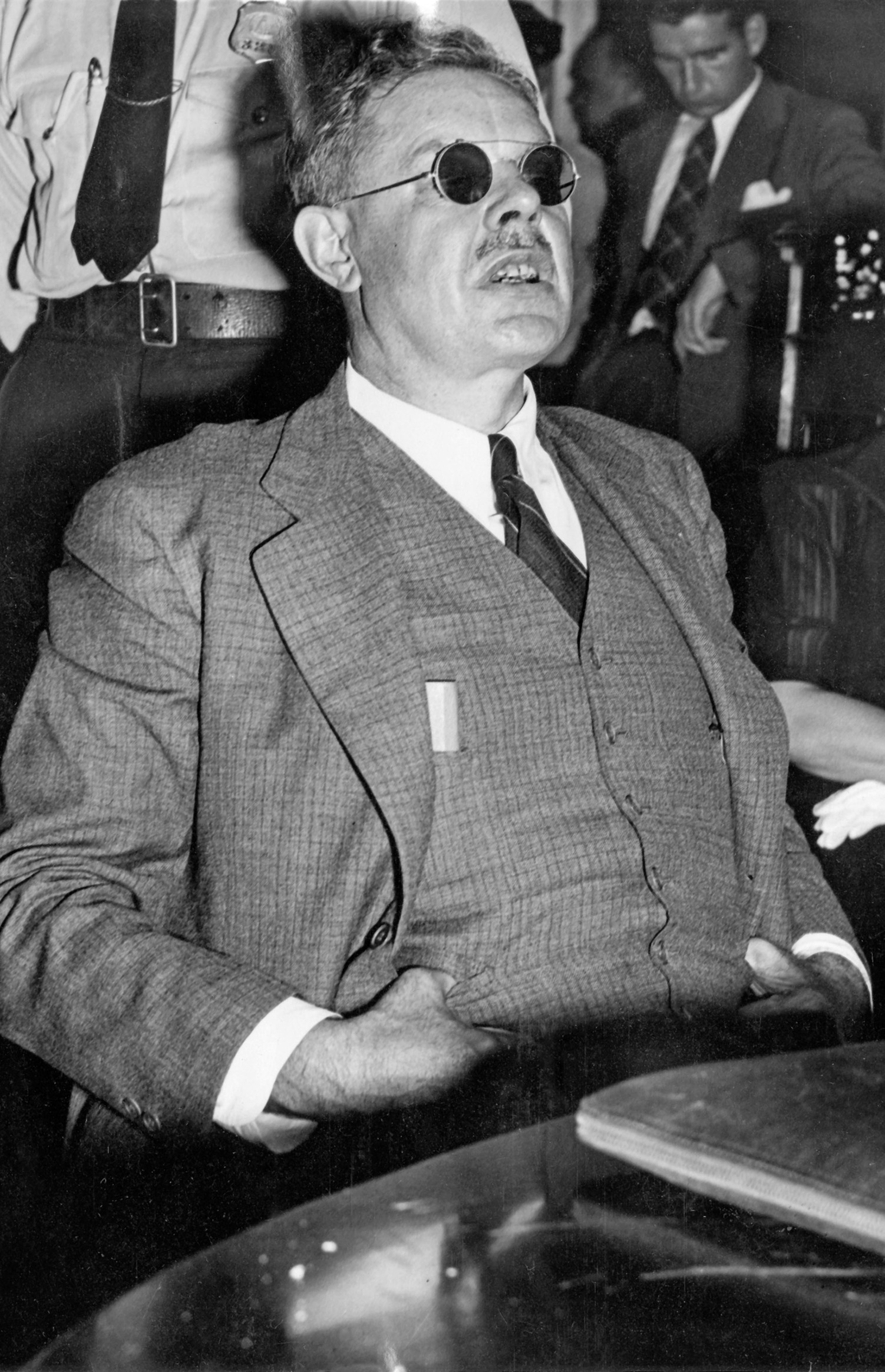
George Deatherage testifying at a hearing of the Dies Committee
With the audience sufficiently riled and their minds on their guns, Moseley would then usher them into the home stretch of his oration, which was always antisemitic, featuring the Big Lie first popularized by Henry Ford: that an all-powerful international Jewish cabal was bent on achieving communist rule in America. Ninety of every hundred commies in America were Jewish, Moseley would shout. Moseley often followed that up with admonitions about why America should not give in to “fear and hysteria” and make the foolish attempt to challenge Hitler’s powerful army in Europe. General Moseley used as an analogy an observation he had made at a “combat royal” cockfight years earlier, where “all the cocks were put in the pit together and there was a terrible melee as they fought each other. But there was one wise old rooster who stayed on the sidelines and watched the battle…. That is what I want to see Uncle Sam do today. Let the foreign nations…expend their strength on each other—as they surely will if we will but leave them alone—and then, let us come in at the end and decide the fate of this funny old world.”
Again, maybe it was just coincidence, but in the aftermath of Deatherage’s sit-down with von Gienanth, Moseley’s rhetoric became even sharper. Nazi Germany, he claimed in a speech to the Women’s National Defense Committee in Philadelphia at the end of March 1939, had a right to be angry at their ill-treatment in the aftermath of World War I: “ Why is the world so surprised at Hitler’s action? His plans to reshape middle Europe have been stated openly and repeatedly. Not so very long ago…the German Ambassador in Washington was at my home. He stated frankly how Hitler desired peace, but Germany must have ‘elbow room’ in Europe for her development, and that the powers must not interfere with Hitler as he reshaped middle Europe to the advantage of the German people.”
The effort to stop Hitler, Moseley averred, was just part of the conspiracy “for the purpose of establishing Jewish hegemony throughout the world…. History will have to repeat itself, and we will have to re-establish the Jew in power, and borrow the money from him. A partner of Kuhn, Loeb & Co., it must be remembered, financed the Russian Revolution, and he was mighty proud of his achievement. Trotsky, under whose orders 3,000,000 Christian Russians were murdered, is now our neighbor in Mexico…. What a beautiful picture it will be. Your sons and mine (I have three) fighting shoulder to shoulder with the Communists of Russia and being paid with money borrowed, probably from the Jews.”
“ Hail Moseley!” read a pamphlet published the next day by a very excited American fascist from nearby Stoddartsville, Pennsylvania. “U.S. Army Major-General Brands Jews as World War-Mongers Working to Have America Force Germany to Reinstate Refu-Jew Communists.” Moseley later admitted this pamphlet was something of an embarrassment but explained that he didn’t “ go around kicking people that are trying to be friendly, in the pants.”
A month later, General Moseley took his ugly talk to a whole new level in Springfield, Illinois. He was particularly riled because a major radio network had refused to broadcast his speech that day across the nation, citing Moseley’s religious bigotry. The general’s reaction to this mid-twentieth-century version of being canceled was unhinged. “ Probably all our names will be taken down and listed for liquidation,” he told his “Christian” audience in Springfield. “But no, the tide is turning definitely in America from coast to coast, and if there is going to be any liquidation, it may be of a very different order.”
He thought America should start things off with a new, very Moseley immigration policy. “Over 2,000 years of recorded history shows very clearly that those traits which have made the Jew unwelcome every place he has been domiciled cannot be bred out,” he said. He called for a program of “selective breeding” that included sterilization of Jewish immigrants in America. “If we do not adopt such a course,” he told the good Christians in Springfield, “we can know definitely today that in due time we will be licked by some nation or group of nations that have looked to their manpower and bred it up.”
To which Deatherage and the other American fascists hurrahed. “Hail Moseley!”
Moseley was back home in Atlanta in early May 1939, considering the possibility of making the city national headquarters of the American Nationalist Confederation and planning to take his political road show to the West Coast. He was prepared to do battle. “ If the Jews bump me off,” Moseley wrote to a friend of his in the Reserve Officers Association, “be sure to see they get the credit for it from coast to coast. It will help our cause.”