CHAPTER SEVEN
SILVER SHIRTS
The same week that Lawrence Dennis was melting into the Nazi masses at Nuremberg, and Father Coughlin was crowing to his flock in Chicago from atop his Nazi-lite architectural backdrop, a rookie newspaper reporter was busily trying to herd a hard-won story past skeptical editors and into the typesetting room of The Minneapolis Journal. Eric Sevareid would eventually go on to a long and celebrated career at CBS News and become one of the giants in twentieth-century American journalism. In September 1936, though, he was a twenty-three-year-old kid fresh out of the University of Minnesota looking for his first big front-page headline.
He went by his first name back then, so it was Arnold—not Eric—Sevareid who took the tip from some college friends: a strange political organization appeared to be on the rise in their city—a group calling itself the Silver Shirts. Philip Johnson’s Gray Shirts in New York never seemed to get much beyond picking a uniform and designing banners, but these Silver Shirts guys in Minneapolis appeared to have numbers, and maybe even momentum. The group was secretive in the extreme, perhaps even a tad paranoid, but there might be a story there—if Sevareid could somehow get inside. He decided to embark on his first undercover investigation, presenting himself to the Silver Shirts as a potential initiate.
Sevareid, turned out, had little trouble winning the Silver Shirts’ confidence. They happily invited him into their middle-class parlors, then pulled their lace curtains tight so they could safely read him into their worldview, and in on their plans. Sevareid appeared to be just the sort of person who would bring credit to their cause: a striking young college graduate, tall and sinewy, an outdoorsman who knew his way around a hunting rifle, with a face already weathered by the fierce winds of the northern plains. Sevareid had grown up in a small town in North Dakota (“no roof to the sky, no border to the land,” he said of his native home), where the economy rose and fell with a single crop. “ Wheat was the sole source and meaning of our lives,” he would say. The rhythms of farming, and the brutal yearly battles against nature—which could visit drought and dust, gully-washing downpours and terrifying cyclones, or ghastly infestations of grasshoppers that could wipe out months of labor in a matter of hours—dictated the daily life of the community and shaped its ethos. The Sevareid family neighbors depended on one another to produce and bring to market enough of the high-quality wheat—“No. 1 Hard,” it was aptly named—to tide them over to next planting season. The town was hardworking, interdependent, egalitarian, and small-d democratic; its politics ran conservative. Sevareid described his fellow townsfolk as exhibiting limitless charity toward friends and neighbors and a thoroughgoing wariness of outsiders.
When Sevareid entered the University of Minnesota in 1931 at age eighteen, he still took it on faith “ that [President] Herbert Hoover was a great man, that America was superior to all other countries in all possible ways, that labor strikes were caused by unkempt foreigners, that men saved their souls inside wooden or brick Protestant churches, that if men had no jobs it was due to personal laziness and vice—meaning liquor—and that sanity governed the affairs of mankind.”
Sevareid’s worldview had somewhat broadened by the time he became a full-time staff reporter at The Minneapolis Journal, but he was still at ease with the conservative older white Protestants who were filling up the roster of the local chapters of the Silver Shirts, and they were at ease with him. Which meant a bunch of them were willing to confide in the young man. Or at least willing to confide what they could, given that anonymity and need-to-know compartmentalization of information were standard practice at the Silver Shirts. The group was organized around “councils of safety,” each consisting of nine members so that no one person could know the identity of more than eight other Silver Shirts. Sevareid was unable to get specific names off the master list held by the Minnesota state chairman, but he was able to get some ballpark numbers: the Silver Legion had just begun organizing in Minnesota a few months earlier, but there were already almost five hundred enrollees in the Fifth Congressional District alone and around six thousand statewide.
The mission of the organization, as expressed to Sevareid by his Silver Shirt recruiters, was disquieting. This wasn’t a do-good service club like the Elks or the Shriners or the Kiwanis; this was a group of vigilantes, gearing up for a quasi-religious, violent crusade. “ One of the Silver Shirt leaders, a retired businessman, led me into his kitchen and opened his cupboards to show me the stocks of canned goods he had accumulated against the day of the Communist uprising, when he expected to barricade himself in his upper duplex,” Sevareid remembered. “He raised a quivering finger and in a quavering voice informed me: ‘If it be God’s will that I fall as a martyr to the cause at the hands of these beasts, I shall die here, in my Christian home, defending my dear wife to the end.’ They were quite mad.”
The fever dream waking these white Christians was fueled in large part by what Sevareid called “secret-society phobia.” Admission to the Silver Shirts had put them inside a special circle of knowledge. The veil had been lifted from their eyes; these Twin Cities burghers suddenly found themselves part of the select few to whom the fearsome truth had been revealed. A dastardly conspiracy was at play in the United States. The conspirators had been identified—commies, Reds, pinkos, otherwise known as international Jewry. They had infiltrated the highest levels of the American government. President Roosevelt’s real name was Rosenfelt! The Silver Shirts in good standing were kept abreast of the current threat level thanks to the newsletter mailed to them, weekly, from the national headquarters of the Silver Legion, somewhere in North Carolina.
“ Oh, we’ve known for a long time that the Jews are plotting to seize the United States government,” one earnest and inflamed Silver Shirt told Sevareid. “They want to run the whole world and tell us what to do. Just look at Russia—the Jews certainly got Russia, didn’t they?”
Sevareid began sketching out what would become a five-part series on the Silver Shirts, running early drafts up the flagpole to his editors. “ Hate and fear bind the members together,” Sevareid had written. “Anti-Semitism is the outstanding feature of the Silver Shirts. Absurd as it may seem, to them the [first] World war, the present war in Spain (from where the Jews were expelled in 1492) and all the wars of the world were deliberately inspired by Jews…. In the minds of [the Silver Shirts] all Jews are Communists and all Communists are Jews. If one points out certain known Communists are definitely Nordic, their answer is—‘Well, he must have a Jewish mind.’ ”
Sevareid had a good look at the “anti-Semitic poison” they were trafficking in and feared it was already spreading well beyond the membership. He knew the Silver Shirts in Minneapolis were passing around something called the Protocols of the Meetings of the Learned Elders of Zion and handing out their already-read copies of the weekly newsletter to uninitiated friends and neighbors so they too would learn that the time might soon come when they would need to be courageous enough to treat the Jews “drastically.” The Silver Legion newsletter also offered the occasional vocabulary lesson: “ Pogrom, lest there be any among us unfamiliar with the word, is a wholesale slaughter of Jews merely because they are Jews.”
Arnold Sevareid took the Silver Shirts at their word, and he took them seriously. The hard-boiled city editor at The Minneapolis Journal, however, wasn’t ready to buy the story at first—not from a wet-behind-the-ears cub reporter anyway. So, he too managed to get invited to a meeting of the Silver Shirts to check it out for himself. Sevareid was in the office when his editor returned from that conclave. “ Get me a drink, quick!” the editor yelled. “God, I feel I’ve been through the most fantastic nightmare of my life.”
Although he no longer doubted the shocking details in Sevareid’s rough drafts, he was still not convinced of the wisdom of publishing the story. A few local rabbis and prominent Jewish civic leaders counseled the editor to drop the entire enterprise. “It would be painful to them, most undignified, and would merely drag out into the open and abet a virulent form of anti-Semitism,” Sevareid remembered years later. They thought it “ better to ignore the madmen and pretend they didn’t exist.”
The young reporter held his ground. The Silver Shirts, he insisted to the city editor, were a serious threat. Readers needed to understand just how dangerous these wild conspiracy theories were, and just how widespread. Sevareid wasn’t looking to embarrass anybody. He wasn’t even going to name names, except for one big one—the man who seemed to have seduced all these midwestern bourgeois. “ I spent hair-raising evenings in the parlors of middle-class citizens who worshipped a man named William Dudley Pelley,” Sevareid wrote. “To his followers—supposedly 6,000 in Minnesota—Pelley is the coming saviour for the nation. They believe he is the man to do what Hitler has done in Germany.”
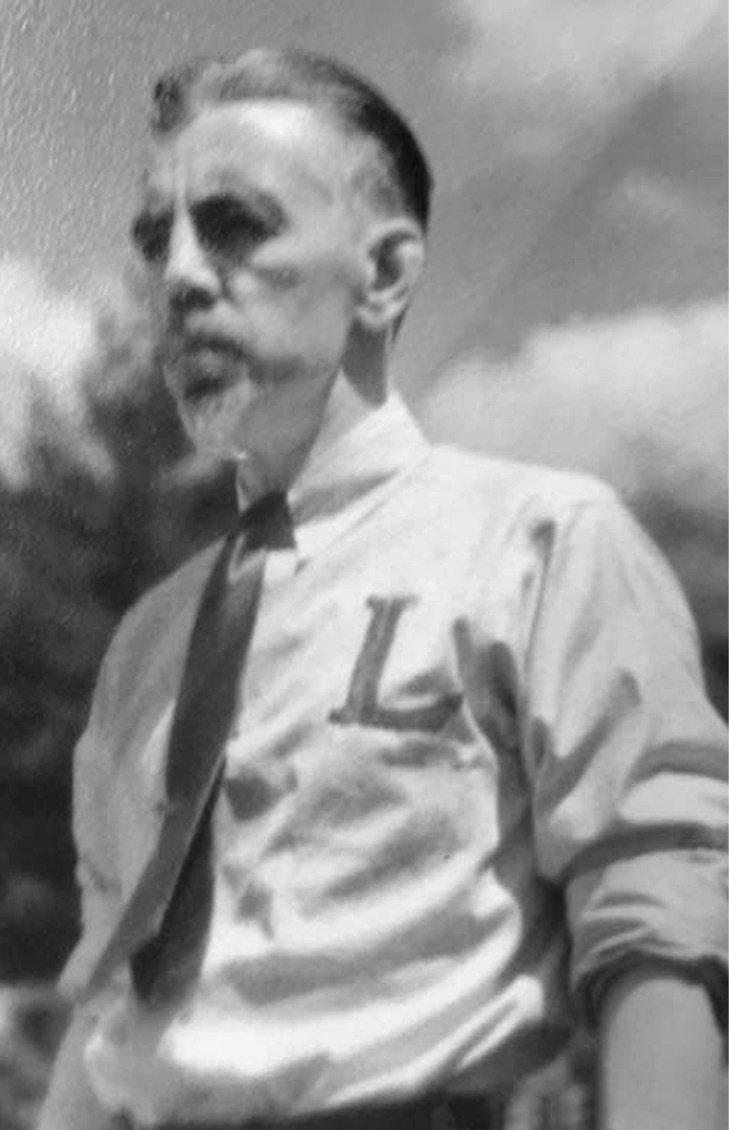
William Dudley Pelley in his Silver Shirt uniform
William Dudley Pelley, like a slug, left behind him a visible, mucoid trail by which we can still know him today. The story of his strange life and his prodigiously vicious political legacy are well recorded, both because of his own enthusiastic telling and thanks to the accounts of dozens of witnesses, informants, and documents that make up the 717-page dossier the Federal Bureau of Investigation accumulated on him in a six-year period beginning in 1933. This much is indisputable: where Lawrence Dennis, self-proclaimed intellectual godfather of American-style fascism, was at pains to mask his personal grievance behind a veneer of scholarly theorizing, Pelley was fearless about using his own compulsive resentments as a tool and a weapon. He sharpened them into something dangerous and lethal and then manufactured it for mass consumption (and for profit)—at the very moment when millions of Americans were looking for somebody to blame, and to punish, for the terrifying want and woe that had been visited on them in the Great Depression of the early 1930s.
Pelley, born in 1890, had come of age like most Americans in his time, which is to say, clinging to the bottom rungs of the country’s slippery economic ladder. He was raised in a deeply Methodist household in the stony hills of Massachusetts and Vermont, with a wealth of religious fervor and forced piety—and little else. He would later describe himself as “ a perpetually hungry, shabbily dressed, and none-too-happy youngster who had to start his life labor at fourteen years of age and stay with it thereafter…a wry, lonely, misunderstood childhood, cluttered up psychologically with the worst sort of New England inhibitions, revengeful that I had been denied social and academic advantages for which my hunger was instinctive.”
William Dudley Pelley did not cut a particularly remarkable figure in his adulthood. He did exhibit a flair for the dramatic in his clothing and in his close-trimmed Vandyke beard, but that was about all that stood him apart as a physical presence. The description of Pelley in the FBI files is terse and to the point: 5-8, 150 pounds. Dark brown hair turning gray. Sallow complexion. Good teeth. Squint-eyes. Rimless nose glasses, octagon lenses. Tendency to cock his head to one side when talking.
Pelley did, however, have indisputable talents, which he recognized in himself and cultivated. He had been a voracious reader from childhood, and though by no means a literary stylist, he was a crack storyteller with an instinct for popular taste. Pelley published scores of well-circulated short stories in his twenties and thirties, including one that shared the second annual O. Henry Memorial Award with F. Scott Fitzgerald and a dozen other writers. Beginning in 1917, Pelley threw himself into the emerging American medium—the cinema—adapting his own stories or writing original scenarios and screenplays. He penned vehicles for early movie stars such as Lon Chaney (The Shock), Tom Mix (Ladies to Board), Hoot Gibson (The Sawdust Trail), and Mary Astor (The Sunset Derby).
Pelley got big eyes living among what he called the “Flesh Pots” in Hollywood. But his dream of becoming a publishing magnate like Richard Simon or Max Schuster or a movie mogul like Louis B. Mayer or Samuel Goldwyn or Harry Cohn never panned out; he remained a cog in both those industries all through the 1920s, with unfulfilling sidelights in restaurants and real estate. A quarter century into his life labor, Pelley was, by his own admission, a surly young man spoiling for a fight. “ It made me a lone wolf at life, getting the least bit mangy as I reached my forties.”
The media maven wannabe did finally hit on a promising vein of commerce around 1930: a combination of charismatic Christianity and the occult. On three separate occasions, he claimed, he had received urgent messages from the world beyond. In the first instance, while alone in a cabin in Altadena, California, he had a near-death experience, the highlight of which was a brief interlude in the afterlife. He described the scene in cinematic detail in “Seven Minutes in Eternity,” which was published as the lead story in the March 1929 issue of The American Magazine (which boasted a readership of 2.2 million): “ A sort of marble-tiled-and-furnished portico the place was, lighted by that soft, unseen, opal illumination, with a clear-as-crystal Roman pool diagonally across from my bench…. Out beyond the portico everything appeared to exist in a sort of turquoise haze.”
Pelley said his second spectral visitation happened while he was at home in California, reading an essay by Ralph Waldo Emerson. “ I had a queer moment of confusion, a sort of cerebral vertigo,” Pelley wrote, “then a strange physical sensation at the very top of my head as though a beam of pure white light had poured down from above and bored a shaft straight into my skull. In that instant a vast weight went out of my whole physical ensemble.”
The third and most dramatic visitation came when Pelley was alone in a railroad car, reading Emerson again, somewhere in New Mexico, as his train “clicked monotonously, eastward, eastward,” he wrote. “ Suddenly as I turned a page, something happened! I seemed to be bathed in a douche of pure white light on that moving Pullman. A great flood of Revelation came to me out of which a Voice spoke such as I had never heard before. What it said, I prefer to keep permanently to myself. But…I knew of the reality of that Entity whom the world now designates as Jesus of Nazareth! I knew that He was not a mythical religious ideal. I knew His ministry and career had been a literal actuality and that I had once seen Him when He was thus in His flesh!”
In Pelley’s telling, which he retailed to millions of paying readers across America, he emerged from his three otherworldly experiences as a man reborn, in myriad ways. He no longer required alcohol, tobacco, or caffeine to get him through the day; was no longer plagued by nervous indigestion, or any of his other daily physical ailments. His spine straightened, his shoulders broadened, his waist grew thin, while his chest and biceps swelled—all without benefit of exercise. He was lighter, friendlier, easier in his skin, easier in the world, because he was now in possession of the answers to the mystery of life.
“The day is coming in the evolution of the race when spirituality is going to be the whole essence of life instead of the world’s present materialism,” he explained to those 2.2 million readers of The American Magazine. “A wholly different universe that seems filled with naught but love, harmony, good humor and prosperity.”
Pelley got letters from readers by the hundreds, a “clean-cut cross-section of Americans and Englishmen,” he wrote. “From railroad and bank presidents; from stenographers and street-car conductors; from…octogenarians to boys and girls in high schools and colleges—men and women being equally represented, and…Protestant ministers, most eager of all to lead their flocks into a clearer understanding of the eternal verities.” But Pelley sensed that the story needed an even more dramatic twist.
So he cooked one up.
The visitations, he began to insist, had changed him in one other fundamental way that he hadn’t previously mentioned: he had become a human radio receiver, able to “tune in on the minds and voices of those in another dimension of being.” He would sit for hours, he claimed, three or four times each week, furiously taking dictation from the learned souls of the Fourth Dimension. “ I have in some cases taken down ten-thousand-word lectures on abstruse aspects of science, physics, cosmology and metallurgy,” Pelley wrote. “I have taken down a 400-page book on Political Economy so advanced in context and knowledge that it has surprised authorities on the subject who have perused portions of it.”
Pelley’s first big effort to monetize his new-won occult knowledge was in the summer of 1932, when he and a handful of acolytes moved to Asheville, North Carolina, and started Galahad College, where students could buy and read the various textbooks on science, physics, cosmology, metallurgy, and political economy Pelley had dictated from those learned souls of the Fourth Dimension. Galahad appeared at the outset a promising venture, at least to folks in Asheville, which, like every other town in America in the 1930s, needed a jolt to the local economy. Pelley was establishing an institute of higher learning and a publishing house, both of which were paying office rent and creating jobs for the locals. An officer in the Asheville Chamber of Commerce invited Pelley to speak to the Kiwanis Club. Pelley’s topic was to be the “Foundation for Christian Economics,” but he veered off into a discussion of the awesome power of solar rays, and a warning to the weirded-out Kiwanis that an apocalyptic eclipse might be in the offing.
One Asheville businessman got an earful he wouldn’t soon forget from Pelley’s right-hand man, Robert Summerville. “ It seems—and I also recall again from Mr. Summerville—that both he and Mr. Pelley were the reincarnation of souls who had lived thousands, if not millions, of years ago upon the earth,” the man later told an FBI investigator. Pelley and Summerville also seemed to think they knew a good deal about the Great Pyramids in Egypt. Summerville, the local man said, “explained to me how the scientists had discovered the interior vaults of the Great Pyramid contained marks which corresponded to what he termed ‘great tribulations’ or ‘crises’ in world history. This began with the exodus of Jews from Egypt, and had such dates as the Fall of Babylon, Rome, and the World War. There were marks from the year of 1931, which Mr. Summerville said was the Depression which would end accordingly in the Great Pyramid on September 16, 1936…. Mr. Pelley is a very intense personality…. He strikes me as having a great deal of the poseur in his make-up.”
Galahad College foundered in a flash. The first class was a small cohort, textbook sales didn’t cover costs, and half the students bailed before the summer session of 1932 was complete. Pelley’s Foundation for Christian Economics and his publishing house both neared bankruptcy, too, and he was soon skipping rent payments to his landlords at the Woman’s Club Building in Asheville.
Pelley appeared destined to take his place in America’s long line of failed and forgotten pseudo-religious charlatans, until in 1933 he hooked his buy-my-psychic-claptrap scheme onto the most rapidly ascendant and dynamic political movement in the world. William Dudley Pelley was able to do this, he claimed, because he knew it was coming. The start date of this new epoch in history and politics had been revealed to him four years earlier, he said, back in 1929, by his ethereal interlocutors, or the hieroglyphics on the interior wall of the Pyramids, or Jesus of Nazareth himself (Pelley never practiced strict consistency in his storytelling). An anonymous writer for Pelley’s new weekly magazine (likely Pelley himself) concocted the story that he had been preparing for this day in secret since 1929, during which time he had “ perfected a great national organization drawing people of importance from the highest walks of life, people whose names have never been published, and may never become known…. On January 31, 1933, the date that Hitler came into power in Germany, Pelley came out from under cover with his Silver Shirts national organization. Having planted depots throughout the entire United States, enlightened police and vigilante groups, secured the cooperation of outraged Christian citizens…. His organization of Silver Shirts is now snowballing exactly as Hitler’s Nazis snowballed in Germany when at last the German people were persuaded to the truth.”
Pelley believed Hitlerite fascism could be replicated in America for one simple reason. Unlike Pelley’s failed spiritual movement, this new political juggernaut was fueled by the most powerful of human emotions. Love and harmony were nice and all, but for pure motive force, hate trumps. His weekly the Silver Legion Ranger provided readers with somebody to hate—the Jews, who were busy planning world domination. Their plot, according to the Ranger, was vast and ambitious. Per Pelley, the Jews had a unified and secret global plan to “corrupt youth through subversive teaching”; “destroy family life”; “dominate people through their vices”; “abase art and corrupt literature”; “undermine the respect for religion”; “ruin the nervous system through inoculations and various poisons, and germs of disease”; “poison the relations between masters and men through strikes and lock-out”; “let industry exhaust agriculture and gradually transform industry in wild speculation”; “grant universal suffrage, so that the destiny of each country is entrusted to men who lack culture and breeding”; “organize vast Monopolies, in which all private fortunes will be engulfed”; “destroy all financial stability, multiply economic crises”; “stop the wheels of industry, make stocks and shares crash”; “concentrate all gold in the world into certain hands”; and finally, “exhaust humanity through excessive suffering, anguish and deprivations, for HUNGER BREEDS SLAVES.”
It sounds insane, because it is. But an equally insane number of Americans in the 1930s signed right up for it. Pelley put out the call for “Christian Soldiers” to fight the Jewish menace—anybody eighteen or older, “of reasonably sound health, and not afraid to risk your life and limb for your country”—and enlisted more than fifteen thousand people posthaste. After taking the official Silver Shirt “Oath of Consecration” and paying dues, new members got a weekly mailing of the Silver Legion Ranger and, as Pelley promised, the “shirt of silver with the great scarlet L emblazoned on your banner and over your heart, standing for love, loyalty and liberation.” Duly initiated members were instructed to keep arms and to be ready to bear them.
Pelley, meanwhile, watched with solipsistic interest as Hitler drew all power in Germany to himself in the next few years. “ Read Hitler’s autobiography,” Pelley would tell his closest aides, “and then compare it with my life and note the similarities between us.”
PELLEY ANNOUNCED FOR the presidency of the United States in 1936, of course, and his candidacy was predictably muddleheaded. There was a lot of talk about protecting the U.S. Constitution, though basically all his policy proposals were blatant violations of this document: the chief executive would be given dictatorial powers; the United States would become a corporation, and every (white Christian) citizen would be both a common and a preferred stockholder. In place of capitalism, Pelley proposed a new economic system in which both supply and demand would be strictly and perfectly controlled by government officials. The whole of the plan, Pelley said, “is too big and too dynamic to describe.” Who wanted to get down in those weeds? What mattered was that Pelley, the savior, was going to be in charge and he was going to rid America of the Jewish Bolshevist communists.
Pelley had a lot of make-believe facts and figures at hand to make his case: by his math, a clear majority of President Roosevelt’s brain trust were Jews or Gentile fronts for Jews (whatever that might mean). Roosevelt himself, Pelley said, was also secretly Jewish. Pelley knew this, he said, because the Silver Legion had taken the time to investigate the Roosevelt family tree. They traced it right back to the Jewish Roscampo family, “which was expelled from Spain and settled in Holland.” President Rosenfelt had already allowed the Jews to secretly take control of the United States. “This is OUR country, founded in certain inalienable rights, and consecrated to the perpetuation of definite Christian ideals and customs of living. We propose without further ado, without equivocation, without any silly sentimentality sometimes known as Tolerance, to emasculate the debauchers within the social body and reestablish America on a basis where spoilation can never again be repeated,” Pelley said. “If you are a weakling, or given to compromise, sentimentality, docile acquiescence to intimidation, and nonentity in general, you are not wanted….ARE YOU WITH US? WILL YOU AID IN HELPING ACTUALIZE THE TRUE DEMOCRACY OF JESUS THE CHRIST RIGHT HERE IN THESE TORTURED UNITED STATES?”
Pelley’s bizarre campaign must have been quite a thing to witness. The candidate himself was always armed, decked out in a Sam Browne cross-body ammunition belt and military regalia, and surrounded by a squadron of bodyguards that would have made Huey Long blush. Some of his campaign rallies numbered in the thousands, with the members of his Silver Shirts Christian militia standing at attention, flanking the dear leader. The men were uniformed in their namesake silver shirts with the red silk L over the left breast, blue four-in-hand neckties with their membership numbers stitched on, blue corduroy trousers, and puttees. (The entire ensemble could be acquired for a $6 payment to the Silver Legion.) If you were looking for a signature Silver Shirt fetish, it was probably hierarchy and rank. Below Pelley himself—who liked to be called Chief—the Silver Shirts had commanders, chamberlains, quartermasters, sheriffs, censors, adjutants, pursers, bailiffs, marshals, advocates, scribes, and almoners. And a partridge in a pear tree.
One hot July night at the Deutsches Haus in Los Angeles a special cadre of Silver Shirts and members of the West Coast German American Bund stood at attention while one of Pelley’s lieutenants warmed up the crowd. According to a report in Pelley’s Weekly, the Silver Shirter screamed, “ I have but one criticism to make of Adolf Hitler. In cleaning the Jews out of Germany, he sent too many of them over here!”
Pelley thus took the stage at Deutsches Haus and “for fully two minutes,” one of the attendees reported, “he strutted around [in silence] like a vain peacock.” When Pelley finally did speak, he bashed “the Moscow-controlled and the Jew-infested Rozenvelt Administration,” as well as the Republican nominee for president. “It doesn’t matter who you vote for in 1936—because both candidates are controlled by Jews. But, by the Grace of God, I am going to stop that…. By the Grace of God, I will march up the steps at Washington and show them that this is still a Christian nation!” The Deutsches Haus audience, according to the witness on the scene, “stamped the floor and just about took the roof down.”
“YOU PROBABLY WON’T believe this story” was the lede on Arnold Sevareid’s Silver Shirts series, which debuted in The Minneapolis Journal—front page, above the fold—on September 11, 1936. The young reporter couldn’t have asked for better placement, but the articles were edited in such a way that they didn’t land the punch he had hoped, “ not as I wanted them written, as a cry of alarm,” he would later say, “but as a semihumorous exposé of ridiculous crackpots.” “Ridiculous,” “ludicrous,” “preposterous”—the editors had peppered these signifiers of Silver Shirt fecklessness and absurdity throughout Sevareid’s six-part series. The third-day story had a corker, drawn right from the pages of Pelley’s Weekly: “ The Pyramids of Gizah have forecast dark events for September 16. In the walls of the ‘pyramid’ are graven the symbols which foretell the epochal doings of that day. It can mean nothing else than the seizure of the world by the Jews, a seizure that has been planned since Solomon’s time.”
This world takeover would not pass by Minneapolis, not according to Pelley’s acolytes. The Jews “are going to start through Kenwood and sweep eastward around the lakes and thence across the city,” one of the Silver Shirts had explained to Sevareid. “Yes, sir. September 16 is the day. You want to watch out. We’ve all got orders to stay home and away from windows.”
September 16, which happened to be the day Sevareid’s series ended, passed without incident, but the letdown did not diminish the apocalyptic ardor of Pelley’s followers in Minneapolis or elsewhere. They still had their canned goods tucked in their pantries and their small arms near at hand. Neither did it diminish fear and hatred among the Twin Cities Silver Shirts—much of which was now turned against young Arnold Sevareid. The really disheartening thing, to Sevareid, was that his series seemed to increase the number of locals who sympathized with Pelley’s adherents.
“ Odd characters, fuming and bridling, would march to my desk in the city room and demand to know whether I was a Christian or a Bolshevik,” he wrote of the aftermath. “ ‘Lifelong subscribers’ would lecture me over the telephone, and, when I lost patience and lectured them back, they would call the publisher and I, to my disgust and amazement, would then be lectured by my bosses for being rude to a client. I sat in the balcony of the biggest Baptist church and listened to the influential pastor denounce me as a ‘Red.’ ”
Sevareid received so many threats of physical violence, by telephone and by letter, that his brothers showed up at his apartment, with their guns, and offered to provide protection. Sevareid waved them off, explaining that these blusterers talked a big game but were too chicken-hearted to make a real attack.
Here is the one time when Sevareid might have underestimated the ugly truth of America’s committed fascists. His window into the movement was a small one, confined mostly to those middle-class Silver Shirt homes dotting the Twin Cities, where Pelley’s Weekly and the Silver Legion Ranger sat comfortably next to the King James Bible and Reader’s Digest and the latest catalog from Sears.
Arnold Eric Sevareid did not know, as a Seattle gun dealer explained in an FBI field office report dated September 17, 1936, that the Silver Shirt field marshal Roy Zachary had “called upon him and offered to buy large quantities of ammunition, 30.06, 30-40, .38 super-automatic, .45 automatic and many other kinds. It is alleged that Zachary wanted 15,000 rounds of automatic ammunition. He also desired to buy high caliber rifles in large quantities, claiming he has permits from the local police department for all the side arms which he can buy…. Zachary wanted [the gun dealer] to go to Tacoma and appraise and inventory the stock of the Kimble Company, a bankrupt dealer, who has a supply of arms and ammunition, Zachary stating that he had the cash to buy all the arms and ammunition he can get…. It is also alleged that Zachary had a permit with the signature of Police Chief William H. Sears and admitted that the guns were to be used by Pelley’s private Fascist army in an immense program being planned by the combined forces of the Black Legion, the James True Associates, and the Silver Shirts.”
Neither did Sevareid know that this man called James True was telling fellow fascists that the day of pogrom was approaching, that Father Coughlin “will soon let loose on the Jews” and they should all be preparing. Neither did Sevareid know that this James True had recently filed an application at the U.S. Patent Office for a new weapon, ready for mass production—one he called the “kike killer.”