CHAPTER FIVE
“HE HAD A VERY HIGH OPINION OF ME”
The bells began to ring out across Nuremberg on the afternoon of September 8, 1936, announcing the arrival of the führer at the fourth annual Nazi Party congress—the “Rally of Honor.” The city had swelled to a temporary population of 1.5 million, triple its normal size. Thousands of special trains had been rolling into the rail yards for days, disgorging party officials, district leaders, cadres of uniformed Nazi youth, members of the Women’s Labor Service and Bund Deutscher Mädel (the League of German Girls), soldiers from infantry, artillery, and armor, and the ubiquitous Brownshirts, or storm troopers. The twenty-five-thousand-man Schutzstaffel was making its debut in Nuremberg that week and drawing plenty of attention in their menacing jet-black uniforms. The newly outfitted SS troops were on hand for dignitary protection, crowd control, and general-use head cracking. Freshly mounted loudspeakers at the train station were still barking out instructions to the new arrivals, herding them toward their assigned tent camps, and keeping the platforms clear for the next train.
Private homes and public inns were stuffed full; the tent cities and the hastily constructed wooden barracks ringing the medieval city were nearing capacity also. The core of the city teemed with newcomers that day. “All day long streets have been filled with marching Storm Troops, Special Guards, party leaders, and Hitler youth,” wrote an American newspaperman on hand to report on the Nazi congress. He estimated 200,000 political workers, 90,000 storm troopers, and 50,000 Hitler Youth. “Together [they] will produce later that mass hysteria that hypnotizes both participants and spectators.”
When the bells signaled the arrival of Hitler, the sea of Nazis washed toward city hall to catch a glimpse. A fascist-leaning history professor from American University in Washington (in Nuremberg for research of an academic nature, no doubt) caught sight of a tall, square-jawed American man whom he recognized as an ideological compatriot. “I have a very vivid impression of you striding down the streets of Nuremberg,” the professor later wrote to Lawrence Dennis. “I wanted to catch up with you but you were lost in the crowd and my search was in vain.” Dennis’s biographer Gerald Horne would later write that in that moment America’s most outspoken fascist “symbolically melted into the Nazi mass.”
Poor Philip Johnson, left leaderless by the death of Huey Long a year earlier, was now stuck in Chicago, forty-five hundred miles away and still looking for his place in any authoritarian movement, while his ideological guru, Lawrence Dennis, was in Nuremberg, invited into the engine room of the global fascist enterprise. Dennis was one of a few hundred foreign diplomats, dignitaries, and “thought leaders” the Nazis had deemed sufficiently sympathetic to Hitler’s politics to warrant an invitation to observe the proceedings in person. Dennis was already well known to officials up and down the line at the German embassy in Washington, where they maintained a growing file of newspaper clippings by and about the erudite American.
Lawrence Dennis’s biographical file alone must have seemed full of possibility to the Nazi officials posted in the United States. He had spent much of his youth in Europe, was fluent in French and German, and had passable Spanish. His time on the Continent had delayed his formal education, but Dennis had finally graduated from the elite prep school Phillips Exeter Academy in 1915, and after a brief sojourn as a junior officer in the American Expeditionary Force in wartime France he got his Harvard degree in 1920, at age twenty-six. He counted among his prized acquaintances a son of Theodore Roosevelt’s, a scion of the estimable Brown Brothers Harriman banking concern, and Joseph P. Kennedy Sr., the wildly successful financier who had just served as the first chairman of the new Securities and Exchange Commission and was soon to be confirmed as U.S. ambassador to Great Britain.
Dennis had spent nearly a decade as a diplomat in training in the U.S. State Department. His first foreign posting was in Bucharest in 1920 (where he was accorded the decoration of the Order of the Star of Romania from his host government), and from there he distinguished himself in the revolutionary hot spots of Haiti, Honduras, and Nicaragua. Though he never rose above the rank of chargé d’affaires, Dennis was asked to go mano a mano with several Latin American strongmen and would-be revolutionaries whom the Coolidge administration deemed less than hospitable to American interests in general and American commercial interests in particular. Despite his success there, Dennis left the State Department unexpectedly in 1926, in a huff, complaining on his way out the door about a promotion system that favored connections and upper-class manners to actual abilities and intellect. His squawking got him a good bit of ink in newspapers across the country, and he leaned into the role of a well-informed and mordant social critic.
Dennis testified to Congress and spoke to reporters about American business interests’ insistence on stripping Latin American nations of their sovereignty and then fouling up their national finances to a fare-thee-well. He took a cynical scythe to American sweet talk about democracy. “ We have founded recent American policy in Nicaragua on the naïve assumption that what Nicaragua mainly needs is fair elections and freedom from revolutions,” he preached. “As a matter of fact, among the things Nicaragua most needs are not electoral and civil policing, but primary instruction, sanitation, means of communications, and a better economic structure…. These, however, are not exported in the soldier’s knapsack.”
By the end of 1930, Lawrence Dennis had turned full-time to writing political treatises based on what he had seen at the crossroads of American foreign policy, domestic politics, and private banking. He liked attention, and he liked to shock his audience. Expounding angrily on American hypocrisy and the shortcomings of American democracy got him the reactions he desired. (He would have been a real star on Substack.)
Dennis entered the field of political philosophy at an opportune moment for someone who self-identified as a “maverick” and a “dissenter.” The waves of economic disaster that roiled the country and the world after the stock market crash of 1929 (Dennis had prophesied the crash, according to Dennis) opened the field for radical new notions about ripping out existing political systems at their roots and remaking the world in an entirely new image. By the time Hitler rose to power in 1933, Dennis was evangelizing for a strong, unimpeded central government of intellectual and technical elites to plan and run the American economy for the long haul, with no heed for the next fast-approaching election cycle. He cultivated a reputation as an astute and fearless champion of European-style fascism as the irresistible next (and preferred) means of American governance.
So it’s no wonder that whenever Lawrence Dennis came to Washington to, say, make a speech at the Shoreham Hotel ballroom—“Is Fascism in the United States Inevitable?”—German diplomats would invite him to dinner to flatter him and fill him in on all the latest exciting happenings in Berlin. It was not hard to see why Lawrence Dennis had been marked as a potentially very useful tool of the Nazi cause in the United States. And Dennis seemed more than happy to play that role.
By the season of the 1936 “Rally of Honor” for Hitler in Nuremberg, the Dennis file at the German embassy bulged not only with clippings about his various speaking engagements up and down the Eastern Seaboard but also with reviews of his most recent book, The Coming American Fascism. “ Until Mr. Dennis arrived on scene,” one reporter noted at the time, “American fascism did not have a prophet.”
Lawrence Dennis was both an outspoken proponent of Hitler-style authoritarianism and an avowed isolationist, opposed to American involvement in foreign wars, especially any war in Europe against Hitler. Simultaneous advocacy of these two copacetic positions was clearly no coincidence, but Dennis portrayed it as if it were. “ I took my isolationism from George Washington’s Farewell Address and from a long line of classics,” he would say. He counted among his friends the most committed isolationists in the U.S. Congress.
The Hitler government’s special summons to Nuremberg was the cherry on top of what had been a fascinating months-long string-gathering sojourn in Europe for Dennis, in the summer of 1936. By his own later description, Dennis had been received and celebrated by intellectual, diplomatic, and political elites from one side of the Continent to the other. The most consequential political theorist of the day, the economist John Maynard Keynes, had invited the American to lunch to discuss ideas. The famous British economist “had a very high opinion of me,” Dennis bragged. “I was very greatly touched by the fact that he had read my book and read my stuff.”
Dennis also had an informal chin-wag with one of the leading left-wing thinkers in Britain, who was also one of his occasional debating opponents, the former MP John Strachey. (Strachey was likely unaware of his wife’s lusty pursuit of Dennis back in New York a few years earlier.) As he did with Keynes, Dennis bragged on Strachey’s attentions. He “ thought very highly of me,” Dennis said, and “ had read my latest book and considered it a thoroughly sound and adequate exposition of the subject.”
Dennis was also received by government officials in Paris who were just then taking stock of Hitler and his regime. “ There were no pro-German French,” Dennis found, “but there were many French who were against their getting into war and wanted to be neutral.” In Moscow, Dennis was shown around by George Kennan, a future architect of American Cold War policy, who was then a thirty-two-year-old chargé d’affaires. Kennan hosted Dennis for meals, took him on the party circuit, and updated him on the current state of the pseudoscience we would eventually call Kremlinology.
Dennis also made a brief but useful visit to Rome. The Mussolini government, having been given a pass by world leaders when it seized Ethiopia by military force just a few months earlier, was clearly tightening its alliance with Hitler and “wanted America to stay out of” any future war in Europe. Mussolini granted Dennis a private one-on-one meeting that lasted an hour, and although Il Duce was close-lipped (“cautious but friendly,” in Dennis’s telling), Dennis nevertheless deemed it a success. “ I just wanted to be able to say that I had met him or seen him,” Dennis explained.
All those meetings paled in comparison to the invitation to the Nazi Party’s Nuremberg show of strength; this was where the real action was in Europe that summer. “ Leaving now for Nuremberg,” he wrote home to his wife, Eleanor, at the beginning of September, “where the world will be told where it gets off and what’s going to happen, or, at least, where it could be so told by der Fuehrer.”
Eleanor Simson Dennis was home in America that summer, tracking her husband across Europe. “They must love you over there for your understanding,” she had written to Lawrence from the couple’s farmhouse in the Berkshires in Massachusetts. In another, she seemed to gush. “ When this reaches you, you will be in Deutschland,” she wrote, “right in the heart and pulse of that wonderful nation where men are he-men and women are so womanly…. Be nice to all the Germans for me and especially to those brave women who are making babies for Hitler and being slaves so happily and willingly to their men.”
Mrs. Dennis had trained in ballet in France and was running her own dance academy in New York City when the couple met a few years earlier. But by the summer of 1936, that dance school was in the rearview mirror. She was living at the family’s ramshackle farmhouse in rural Becket, Massachusetts, trying to make ends meet on her husband’s spotty income (thank God for occasional checks from Dennis’s gazillionaire devotee, Philip Johnson), minding a two-year-old daughter, and about to deliver a second child. All mostly on her own. In fact, when Dennis extended his stay in Europe to watch the Nazis at work and play, he missed the birth of his second daughter, which occurred on September 6, 1936, two days before the opening of the Nuremberg congress.
Dennis’s stated views on women and society were about what you might expect (“ the paramount objectives of public policy, so far as women are concerned, should be to make good wives and mothers and not to make as many soft berths as possible for old maids and thus to put a premium on the avoidance of marriage”). That blunt, bitter tone wasn’t reserved for his pronouncements on gender relations. It was part of what made Dennis the leading spokesman for fascism in America in 1936, and also an exemplar of why certain people found comfort in authoritarian ideology. One big appeal of fascism, if nothing else, was its unapologetic embrace of cruelty. Cruelty toward others, coupled with hypersensitivity toward any slight to oneself.
Reading Dennis’s books, articles, and interviews, listening to tapes of his lectures and debates, you get a feeling for a man acutely aware of any affront, cloaking personal insecurity with an armor of certitude. And then that mean streak. “ Human nature has not changed materially under liberal capitalism,” he wrote in 1935. “The masses have not the intelligence or the humanity, nor the winners the magnanimity, which liberal assumptions have postulated.” Lawrence Dennis put on a clinic in name-dropping (Keynes “had a very high opinion of me”); elitism (“ Social order requires government and administration by a ruling class or power-exercising class which must always be an aristocracy of management, however selected…. For the masses, the school is a necessary process to enable them to read signs and advertisements”); and feigned insouciance (“ I’m not very emotional anyway, and I couldn’t share the American pro-British and anti-German” feeling).
Dennis, would-be Übermensch, often described himself as a man who operated outside the realm of passion—which suggested an extreme lack of self-awareness or a deep need to hide his true self. Anne Morrow Lindbergh, the gimlet-eyed wife of America’s hero flier and notable Nazi sympathizer Charles Lindbergh, spent hours in Dennis’s company talking political philosophy and parsing world events, but never really got a handle on what was driving him. “ He was rather reserved and extremely sensitive,” she wrote of Dennis. “His brilliance carries you along ‘with the greatest of ease.’ I only find myself disturbed by that curious downward pout of the mouth that is almost like the terrible mouths of the Greek masks for tragedy. He has suffered, this man, been badly hurt—why, I don’t know, and it seems to have left him with that curious grimace (terribly revealing, changing a whole face in a flash) and with no love of mankind as such.”
“ We aren’t concerned with moral issues,” he had explained in one public debate. “The idea of fascism is to make the show run. In other words, any problem is small if you set up the right machinery to meet it.” That a very large number of people might get chewed up in the works of that machinery was either beside the point for Lawrence Dennis, or exactly the point.
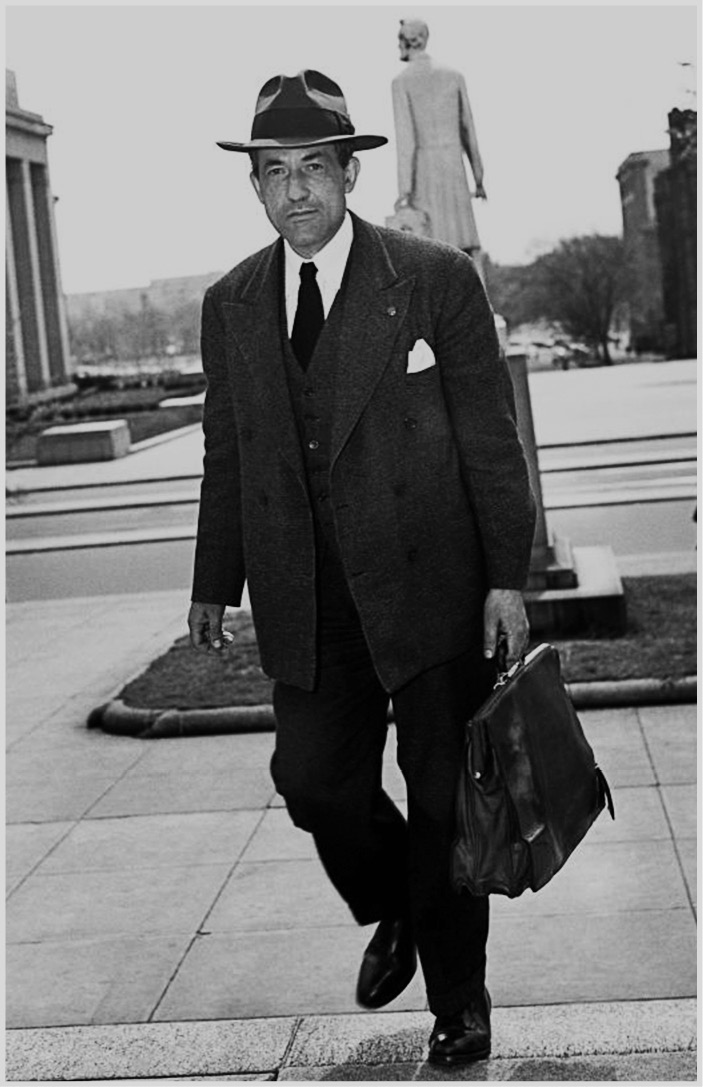
Lawrence Dennis entering court
THE NAZI CONCLAVE Dennis witnessed in Nuremberg was conceived and designed to show the rest of the world just how powerful Hitler’s authoritarian machinery had become. The national economy was humming again, the führer insisted; the German people, united as never before, had been resurrected. Germans would no longer hang their heads in shame at their defeat in the recent world war or live under the restrictions placed on them by the Treaty of Versailles. They had, in defiance of that treaty, built the most powerful military in all of Europe and had already begun to reclaim territory that rightfully belonged to the German people. “ What would our opponents have said had I then prophesized that during these four years Germany would have shaken off the chains of the slavery of Versailles, that the Reich would have regained its defense freedom,” Hitler said in his opening speech at the Rally of Honor. “Had I predicted all these things four years ago I would have been exposed to the derision of the world and branded a madman. Yet in these brief four years all these things have happened, and who would now dare to reproach us for looking back upon these developments with a feeling of pride and satisfaction?”
The totality of Germany’s newfound military power was on display throughout the week. On the third morning of the Rally of Honor, the reconstituted German Luftwaffe appeared without warning in the skies above Nuremberg—four hundred weaponized airships in all: scout planes, followed by heavy bombers, then dive-bombers, and then sleek new monoplane fighters. “Jubilant thousands waved and cheered as the glittering fighting fleet, created since Hitler scrapped the Versailles Treaty 18 months ago, dipped through the cloudless sky over the Reichsfuehrer’s hotel,” observed one reporter.
The flyover was just a warm-up for the display of military maneuvers on the final day of the congress. The drone of planes could be heard before they appeared over the parade grounds that morning, while loudspeakers announced their arrival: the Horst Wessel squadron, the Richthofen, the Immelmann. They flew in, performing choreographed turns and dives until, in climax, a gaggle of seventeen fighter planes appeared on the horizon and then scudded over the gathering in a swastika formation. Tens of thousands of German soldiers then rushed the parade ground. The mounted cavalry rode in through the gates, followed by light artillery and heavy batteries, booming away; then the infantry, covered by artillery and machine gun fire, and supported by columns of tanks, chased a mock enemy off the field.
When the shooting was all done, Adolf Hitler’s voice cut through the smoke-filled air above the faux battlefield. “As I see you before me, I feel, I know, that this guard defends us against all dangers and threats,” he said. “Germany is once more worthy of its soldiers, and I know you will be worthy soldiers of the Reich!… Grave times may come. You will never waver, never lose course, never prove cowardly! We all know that heaven is not gained by half measures! Freedom has no use for cowards! The future belongs to the brave alone!”
This martial spectacle was meant not just for fellow Germans in attendance but for an international audience. It clearly hit its mark, judging from the coverage of the day. “ No other country, not excluding Russia, can produce so great a mass of men of similar intelligence and equal physique, ready or almost ready, to take the field,” wrote a New York Times reporter, clearly impressed by what he had witnessed. “And once more there comes over the beholder the stunning conviction of Germany’s unequalled strength.”
Lest their intended audiences miss the sharper point of this exercise, the Nazis were very clear about exactly where this firepower was aimed: at the great threat to all free men, the communist scourge, those “Bolshevist Jews,” as Hitler called them.
Antisemitism was hotter and meaner than ever in Germany in the summer of 1936. The Nazi Party congress in Nuremberg was said to be considering more new laws to forbid Jews in Germany to own or inherit private property. “ Last summer I found many still believing that the Nazis might moderate and allow German Jews, at least, economic rights,” an American pastor living in Berlin explained. “But this summer finds Jews in Germany even despairing of their future in business.”
There was a clear shift happening just then. Nazi Party efforts to bully Jews into leaving the country were well under way, but the program appeared to be turning into something even more menacing. The American clergyman reported that government officials in southern Bavaria, and even in Berlin, were refusing to renew the passports of Jews living in Germany. “If Germany wants us to leave,” said one Jewish rabbi in Berlin, “they should make it possible for us to go.”
Lawrence Dennis got a close look at what was happening that week in Nuremberg, having been invited into the Nazi family circle. His minder for the festivities was a protégé of Joseph Goebbels, Ulrich von Gienanth, who was angling for a high-level assignment in America. Dennis also received his own small team of uniformed storm troopers to escort him through a carefully planned daily schedule of meals, private meetings, and public events. “ These young Nazi elite guards assigned to act as our hosts and guides lived with us in our hotel,” Dennis later explained. “They had breakfast with us around 8, bundled us off…to the first function of the day around 9…and brought us home around midnight. We were with them the best part of eighteen hours a day.”
The führer even agreed to a brief private interview with Dennis. In private, up close, Dennis found the German dictator unimpressive. Hitler’s talents, he decided, were instinctual and ran to propaganda and political showmanship. Not that Dennis diminished them; there was clearly something to be learned, he later wrote, by watching Hitler ply his dark art. The führer had united the normally fractious German polity around a set of common (and mostly invented) enemies. “ Hitler was able to exploit with guile the gullibility of the ‘best’ people, and with the utmost sincerity the patriotism of the nationalists who wanted to see Versailles avenged,” Dennis wrote. “The anti-communist line got the capitalists, the anti-Versailles line got the army and the nationalists, the anti-Semitic line got the masses as well as the classes.”
Dennis’s main interlocutors in Germany in 1936—Goebbels, Alfred Rosenberg, Rudolf Hess, and Hermann Göring—were more to his liking. They seemed to be thinking men, even intellectuals. “ They didn’t try to propagandize the prominent Americans that they met with,” Dennis later explained. “They made up their propaganda more for the masses. They were very tactful and diplomatic, I thought.” They made sure Dennis understood where their interests met his, and that was in keeping America on the sidelines of any war in Europe.
At one point, and this has been corroborated by both Dennis and his contacts in Germany, Dennis suggested that the Nazis’ treatment of the Jews was not advancing that critical mission. It looked bad. Maybe they didn’t have to be so straightforward about the whole business, he suggested. To strip Jews of citizenship and property rights, they didn’t need overt laws that just came right out and said that. “Why don’t you treat the Jews more or less as we treat the Negroes in America?” he asked.
“ The strongest thing they said to me was, ‘You Americans mind your own business, and we’ll mind ours. You leave ours alone; we’ll leave yours alone,’ ” Dennis explained years after the fact. “Of course, I couldn’t strongly disagree with that.”