CHAPTER FOUR
“LOUISIANA WAS NOT QUITE READY”
The Hitler-adoring, would-be-fascist aesthete Philip Johnson arrived in Louisiana’s capital swelled with his own youthful imaginings. Johnson and his lackey, Alan Blackburn, full of big dreams, nosed their National Party pennant–flying Packard into Baton Rouge in the first days of 1935, when Nazis in Germany were still working out their first run of explicitly antisemitic law. Johnson and Blackburn hoped to hitch their wagon to the shooting star of American politics, the U.S. senator Huey Long, who was already making noise about challenging Franklin Delano Roosevelt in the next year’s presidential election.
Johnson was convinced that Senator Long would immediately recognize the many useful talents he and Blackburn could bring to the Kingfish’s Share Our Wealth political operation. The two could write political speeches (Harvard men, after all), or art direct and produce stylish pamphlets and publications (just look at what they’d done for architecture and design of the so-called International Style). They could even create stages and backdrops for Long’s raucous, immense political rallies (Johnson had seen the nuts and bolts of those awe-inspiring sets, firsthand, in Potsdam).
Problem was, they couldn’t get an audience with Long. Huey Long was a very hard man to get to meet in 1935. In fact, he was pretty much unreachable.
Not that Philip Johnson didn’t know where Huey Long was at almost any time. From anywhere in Baton Rouge, at all hours of the night, Philip Johnson or anyone could see the beacon of light glowing brightly, twenty-four stories high, atop the art deco capitol that towered above the city streets. Huey Long had won the funding for that pricey capitol building in his term as governor, and even though his official job was in Washington, D.C., now, he still reserved a top floor of the capitol in Baton Rouge as his personal apartments. The Olympian altitude, he explained, set him above the pollen and the dust that had long plagued his sleep.
When the Kingfish did emerge from his suites, you could barely see him for the ever-growing cadre of armed men surrounding him, a scene that screamed “dictator” in any language. From the single Louisiana state trooper he had been assigned at the start of his first year as governor, Long’s protection detail grew quickly to include at least a dozen troopers. In early 1935, as the Kingfish’s supporters whispered about rumored marplots and assassination cabals, the head of Louisiana’s Bureau of Criminal Identification kept adding additional state police to the detail. That ever-growing group was further supplemented by civilian toughs who caught Long’s eye.
Long’s little traveling personal army was not armed in any uniform way, but they were amply armed. Murphy Roden, a former state trooper, had a .38-caliber Colt super-automatic tucked into his suit jacket. Joe Messina, a slow-witted two-hundred-pound side of beef with deep-set, wary eyes and a canine devotion to Long—the Kingfish had plucked Messina from his lowly job as house detective at a seedy hotel—carried a small-caliber pistol in one pocket and a blackjack in another. George McQuiston sported a snub-nosed revolver and, on special occasions, a sawed-off shotgun haphazardly concealed inside a paper bag.
These musclemen were not merely for show, as they had demonstrated with increasing frequency—often against reporters who worked for what Long sometimes called the “lyinnewspapers.” In the final legislative session of 1934, Long’s guards arrested two newspapermen who tried to enter the (unlawfully) closed senate chamber. When the photographer Leon Trice snapped a picture of Long bickering with a state representative in the public lobby outside the house chamber, Huey’s enforcers sucker-punched Trice and threw him ass over elbows down a flight of marble stairs. Another newsman reported that Senator Long had “stood by laughing” at the sight of Trice’s head bouncing down the steps.
Trice got it worse six months later, not long after Philip Johnson had arrived in Louisiana. In the first week of February 1935, Trice took an innocuous photograph of Senator Long disembarking from a train in New Orleans. Messina, according to a wire service reporter at the scene, “rushed the slender 125-pound Leon Trice, fists flailing. He shouted, ‘Put down that…thing.’ Messina slugged Trice in the face as Trice pleaded: ‘Don’t do that, Joe.’ Huey said not a word. He stalked with an impressive air to a group of waiting automobiles and, surrounded by his bodyguards, sirens screaming, drove away at terrific speed down Canal Street, ignoring all traffic lights.”
Witnesses said Messina had first beaten Trice with his bare fists and, after the defenseless photographer had fallen, with his blackjack. The beating was so brutal that Trice had to be taken to the hospital, and the district attorney in New Orleans was moved to file charges of assault with the intent to murder against Messina.
The senator’s motley semiofficial protective cohort stood by the doors of the legislative chambers in the capitol as the Boss prowled the floor, buttonholing lawmakers, demanding that they pass his bill to, say, transfer all authority rightfully exercised by the City of New Orleans to the administration of Governor Oscar K. Allen, which is to say to the Long political machine. “ We have a Governor [Allen] who weeps about it like a woman,” noted one informed wag in Baton Rouge, “and serves, like a dishwasher in a restaurant serves his master.” When that particular bill did pass, as Huey’s bills always did, it gave the Long machine direct control of all the thousands of patronage jobs to be distributed in the state’s one true metropolis. This meant yet more control, more power, and not incidentally a huge new haul of kickbacks from the wage earners, whether sincerely appreciative or simply strong-armed.
Long’s bodyguards remained at the senator’s side whenever he strode across the travertine marble floor of the capitol rotunda, down the forty-eight steps at the front of the building (one for every state in the Union), and into his already purring limousine. The bodyguard retinue was always there in Long’s motorcade, too—sirens wailing—with the Kingfish sitting pretty in the padded backseat, smoking his ten-inch cigar.
The men kept a wary eye on other shoppers as Senator Long was measured and fitted for his custom-made silk shirts and double-breasted suits at Godchaux’s department store on Canal Street. They kept bawdy revelers away from Huey’s table at the Roosevelt Hotel bar. The Roosevelt was the city’s first post-Prohibition nightspot to admit women, and the bar’s owner, Seymour Weiss, encouraged the loveliest young salesclerks from Godchaux’s to stop in after a long day’s work. Huey was happy to invite a few of them over to his table to partake of his favorite drink, the Ramos Gin Fizz, which features heavy cream, egg whites, orange flower water, and then a squirt of seltzer to add “a touch of effervescence” to the gin. All the bartenders knew exactly how to mix it to the Kingfish’s specs.
Long’s hair-trigger security detail was particularly watchful when the Roosevelt’s owner, Seymour Weiss, stopped by the senator’s table. Weiss was Huey’s key bagman in the Big Easy, and he often came by with sacksful of cash from companies that wanted a crack at state contracts for highways, bridges, hospitals, schools, and other public works projects, all of which Long controlled.
PHILIP JOHNSON DIDN’T know much about the mechanics of politics, but he intuited enough to realize that it might not be wise to directly approach Long without benefit of an actual and formal invitation. Johnson and Blackburn never did get an audience with Long on their first tour of Baton Rouge. But they didn’t give up. When they found out that Long was decamping from Louisiana to D.C. to check in on his day job in the Senate, Johnson and Blackburn temporarily ditched their Packard touring car and hopped on the Kingfish’s train north. The pair then took rooms in the Broadmoor hotel in Washington, just a few floors below Long’s suites, where the senator liked to meet visiting foreign dignitaries while still in his purple silk pajamas.
Still, despite Johnson’s and Blackburn’s unmistakable show of enthusiasm and fealty, Long had no use for them. He was already long on bootlickers and flatterers, and fine for money, having just pocketed $350,000 in “legal fees” from Louisiana’s Tax and Public Service Commissions, not to mention his under-the-Roosevelt-Hotel-table take from Seymour Weiss and his flood of kickbacks from state employees. The Kingfish did finally agree to a meeting with the strange boys living downstairs from him, sometime around February 1935, but that was as far as it went. When Alan Blackburn leaked a story to a Washington reporter that he and Philip Johnson had mastered a new piece of technology that would be the perfect complement to Huey Long’s indefatigable communication skills (the Visomatic slideshow machine), the Kingfish did not take the bait. He reportedly also had a look at some of Johnson’s amateur attempts at speechwriting and tossed them aside.
Philip Johnson did have a vaguely substantive meeting with Senator Long’s personal secretary, but it did not go well. Johnson was still shaking his head about the episode almost sixty years later, in an interview he gave when the American Academy of Achievement bestowed upon him its Golden Plate Award. Turns out an actual practitioner of power politics was not that much interested in Johnson’s rhetoric, or art direction, or new communications technology, or pseudo-fascist theory. “ One of [Senator Long’s] people said to me, I’ll never forget this, ‘How many votes do you control?’ ” Johnson remembered. The answer would be two for sure, his and Blackburn’s, and maybe a dozen other Gray Shirts’ up in New York City. The way Long’s people saw it, Philip Johnson and his sidekick were a couple of pikers, fascists manqué who didn’t have the foggiest notion what it required to actually accrue power. The way Johnson saw it, unsurprisingly, the shortcoming was on Long’s side, and not Johnson’s. “He was so individual and chaotic that there was no way of getting along,” Johnson said.
By the dog days of summer 1935, Johnson was contemplating whether to take the advice of Long’s secretary, who had told him to ship out to his hometown in Ohio and try a run for Congress under the Share Our Wealth banner. While Johnson and Blackburn had ceased following Long around like excited little pups, the pair was still paying very close attention to the press coverage of his every movement. They were pleased to see that Long was hinting at a third-party run for the presidency in 1936. Even if he was unable to outright win election and remake the presidency in the fashion of his all-powerful consulship in Louisiana, Johnson figured at least his candidacy would likely split the Democrats down the middle. This would deny Roosevelt reelection, and maybe even open the country up to a political free-for-all that could be exploited. And in the lead-up to that chancy presidential campaign season, Long already appeared to have embarked on a project to sow a little chaos.
On the morning of September 8, 1935, according to reports, Huey was back in Baton Rouge, busy whipping votes in a special legislative session he had called. He was about to jam through a bill making it illegal—punishable by fines and imprisonment—for federal officers to exercise any authority in Louisiana that was not explicitly granted by the Constitution of the United States. In blunt terms, Huey was threatening that any federal government officials coming into the state of Louisiana would risk arrest and imprisonment for doing so. It was a big F-U to FDR, and to the whole idea of the sovereignty of the U.S. government. “The broadest and boldest defiance of Federal authority since the Civil War,” wrote a reporter for the United Press syndicate.
Bulletins in the next day’s newspapers, September 9, 1935, were even more dramatic, but for an entirely different reason: Huey Long had been gut shot the night before, at around 8:30 p.m., while walking through the rotunda of the Louisiana State Capitol. Initial reports were as odd as they were alarming. The suspected assailant was identified as an apolitical twenty-eight-year-old ear, nose, and throat specialist who was scheduled to do two tonsillectomies the next day. The doctor had allegedly slipped inside the iron ring of Long’s bodyguards and fired one shot, at point-blank range. The bullet, praise be, had missed all major organs. Doctors had given the Kingfish a series of blood transfusions, according to initial reports, and performed an operation to stop the hemorrhaging. The medical professionals didn’t have a lot to say, but Long’s political team insisted he would pull through.
So the general public, and Philip Johnson among them, was not well prepared at all for the next day’s news bulletin: Senator Huey Long, the ruler of Louisiana and the would-be ruler of the United States, had died of his wounds.
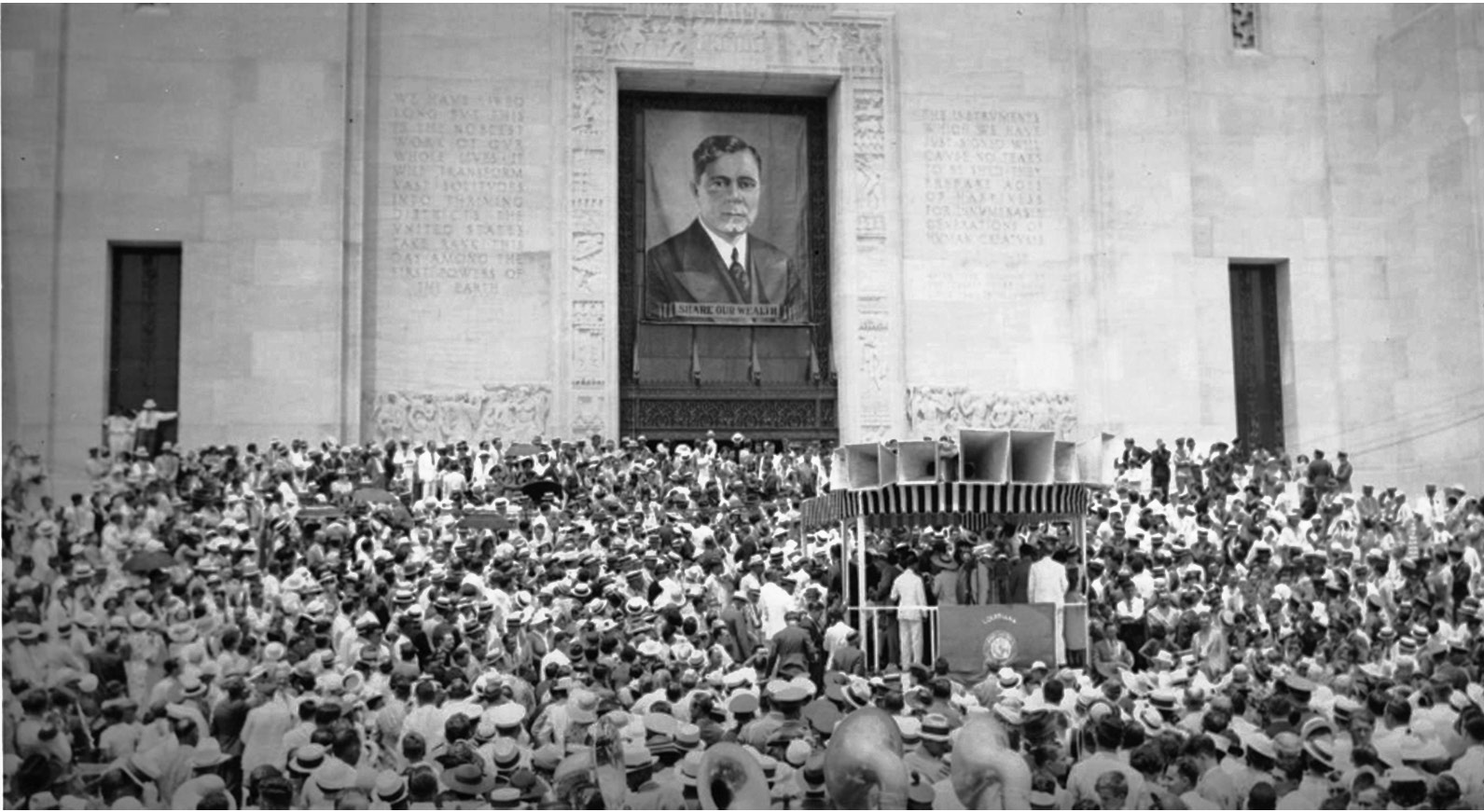
A picture of Huey Long looms over Louisiana’s gubernatorial inauguration the year after Long’s death.
The day of his funeral in Baton Rouge, more than a hundred thousand of Long’s admirers waited in the wet, boiling heat for a glimpse of the passing coffin filled with his mortal remains. “ All day men and women fought for a place near the grave, shoving and tugging against the ropes that police and guardsmen used to hold them back,” one reporter wrote of the scene. “Every fifteen minutes or so an elderly man or woman would crumple quietly to the ground.” A six-year-old girl was nearly trampled in the crush of the crowd. While members of the LSU marching band, in sun-splashed purple-and-gold uniforms, beat out a baleful dirge, and pallbearers shouldered the casket down the forty-eight steps of the capitol, one old-timer fell to his knees. “I don’t care,” said the man. “I’d just as soon die for Huey.”
A representative from Long’s Share Our Wealth Society, the Reverend Gerald L. K. Smith, was the featured speaker in the heat that day. Smith was characterized as “a viper,” “a leech,” “anti-Christian,” and “anti-God” by a fellow clergyman (and this was one of his allies), but he was almost as talented an orator as Long himself. Smith knew how to rile a crowd, from any pulpit or podium, and he certainly did that day. Huey Long “died for us,” he told the overheated assembly. “ The ideals which he planted in our hearts have created a gnawing hunger for a new order. This hunger and pain, this parching thirst for better things can only be healed and satisfied by the completion of that victory toward which he led us…. I was with him when he died. I said ‘Amen’ as he breathed his last. His final prayer was this: ‘Oh, God, don’t let me die. I have a few more things to do.’ ”
NEWSPAPERMEN AND POLITICAL observers weren’t sure what to make of Huey Long’s strange and unexpected death, and they were even more divided on how to sum up his life. Huey Long was a deeply corrupt public figure, hungry for power and money, and remarkably adept at accruing both. But the single idea he rode to political power—that America needed to confront economic inequality and injustice head-on—had enormous appeal. As did the schools and hospitals and toll-free bridges and roads he built. Neither did Long seek to divide Americans, except by class. He loudly proclaimed himself the champion of the have-nots, who are after all much more numerous than the haves. He had “a streak of deep sincerity, a sympathy by no means hypocritical, with the sufferings of the dispossessed, which brought a popular following his other qualities could never have commanded,” The Washington Post editorialized. However, the Post went on, “in the career of Huey Long is epitomized the essential weakness of democracy—the pathetic willingness of the electorate to trust a glib tongue and a dynamic personality. Quite justifiably he was called a forerunner of American Fascism.”
Huey’s death, by chance, happened the same week the Reichstag enacted the Nuremberg Laws and raised high its swastika flag, and so the German führer was on the front pages also, and in the minds of journalists and readers alike. “ That Huey built roads and bridges and provided free schoolbooks nobody will deny, but nobody knows how much they cost or how much money was stolen in the process,” wrote one nationally syndicated columnist. “Huey was gradually copying the Hitler state, but Louisiana was not quite ready for blood purges and internment camps.”