CHAPTER THREE
UMWEGE
If you were a young German attorney looking to make your mark in the all-powerful Nazi Party in 1933, turns out Fayetteville, Arkansas, was a surprisingly auspicious place to be. As part of their crusade to make daily life intolerable for German Jews, the Nazis by then had started enacting a double-edged plan: generating menacing political and cultural cues that encouraged widespread, consistent, and murderous intimidation of Jewish citizens by fellow Germans while also drafting civil and criminal codes that placed all persons of Jewish heritage outside the privileges and protections of the state. Toward that latter aim, one particular foreign country offered a road map of sorts. And so, in 1933, the German Foreign Office dispatched a young man named Heinrich Krieger to the University of Arkansas School of Law.
“ Awful it may be to contemplate, but the reality is that the Nazis took a sustained, significant, and sometimes even eager interest in the American example of race law,” James Q. Whitman wrote in his landmark 2017 book, Hitler’s American Model. “Nazi lawyers regarded America, not without reason, as the innovative world leader in the creation of racist law.”
Whitman’s book made a splash when it was first published in 2017, but his central finding would hardly have been news to the millions of people living under the yoke of legal segregation in the American South in the 1930s. The Pittsburgh Courier—then the nation’s most widely circulated African American newspaper— published an editorial in 1933 titled “ Hitler Learns from America.” Langston Hughes put it more poetically in 1937: “ Fascists is Jim Crow peoples, honey.”
When young Heinrich Krieger was sent to the American South to take notes for the führer, he was quick to see how the United States could provide a sort of conceptual prototype for new German law. Jim Crow laws segregating Black Americans and stripping them of legal and political rights were just one of the many bulwarks in American law constructed for the protection of white people from the “lower races.” In his carrel at the law library in Fayetteville, Krieger was in a catbird’s seat for studying all kinds of finely crafted American statutory racial hierarchy. He was able to conduct a comprehensive study of more than thirty states whose laws and courts forced Black Americans into second-class citizenship, as well as U.S. federal law governing immigration, Indian treaties, and treatment of people in America’s new territorial acquisitions.
In the book that grew out of his year in Arkansas, Das Rassenrecht in den Vereinigten Staaten (Race law in the United States), Krieger laid out his case that “race protection” had been a crucial motivator in the construction of America’s tiered system of justice. He wasn’t out on some weird Germanic limb in doing so; a long line of revered statesmen and political figures had essentially admitted the same. Theodore Roosevelt, for instance, might have castigated Sylvester Viereck as a German agent who should bounce back to Berlin instead of hounding his fellow Americans here, but in his broader view of the human condition Roosevelt saw white Americans and white Germans as allies in an ongoing war between the races in which the white (Anglo-Saxon) man was bound to fight against all comers: Blacks, the Irish (at least until he needed the Irish vote), Slavs, Latins, and Asians. “ From the United States and Australia the Chinaman is kept out because the democracy, with much clearness of vision, has seen that his presence is ruinous to the white race,” Roosevelt had written in 1894. “The whole civilization of the future owes a debt of gratitude greater than can be expressed in words to that democratic policy which has kept the temperate zones of the new and newest worlds a heritage for the white people.”
A crowning achievement in the march of “civilization,” Roosevelt had opined in his book The Winning of the West, was the white triumph over the vast Native population in North America. The conquered peoples, Roosevelt asserted without any actual knowledge, lived an existence “ but a few degrees less meaningless, squalid and ferocious than that of the wild beasts.” (Hitler also took note of that empire-building march with the U.S. cavalry as the spear’s point. Americans had “ gunned down the millions of Redskins to a few hundred thousand,” he said, “and now keep the modest remnant under observation in a cage.”)
When he had become president in 1901, Theodore Roosevelt was still in full cry on the topic of race. His fellow (white) citizens lacked a proper appreciation of the perils at hand, he harangued audiences large and small, or the “courage” to do something about it. White Americans were mixing their genes too freely with other folks, inviting “race suicide.” Roosevelt badgered white women to have more (100 percent pure) white babies. This was “warfare of the cradle,” Roosevelt would say, and “fundamentally infinitely more important than any other question in this country.”
Teddy Roosevelt was a standout, but Krieger had no shortage of material to work with from a long line of U.S. presidents. Both Thomas Jefferson and Abraham Lincoln had expressed hopes that all people of African descent living in the United States would one day be shipped overseas. “ The two races, equally free, cannot live in the same government,” asserted Jefferson, who lived in fear of a slave revolt. Krieger could also point to American presidents of more recent vintage. Woodrow Wilson in 1913 had resegregated the federal workforce by law, purging Black Americans from the best and best-paying government jobs. Calvin Coolidge in 1924 had signed into law radical restrictions on immigration, but not before publishing a stinging little essay in Good Housekeeping magazine titled “Whose Country Is This?” Immigration restrictions, Coolidge wrote under the Good Housekeeping Seal of Approval, were a necessary first step in walling off white America from “ the vicious, the weak of body, the shiftless or the improvident.” These types, he implied, could be identified by nationality and skin color. “There are racial considerations too grave to be brushed aside for any sentimental reasons,” Coolidge wrote. “Biological laws tell us that certain divergent people will not mix or blend…. The unassimilated alien child menaces our children.”
The architect of Coolidge’s 1924 immigration restrictions was a wealthy eugenicist lawyer who went on to form the American Coalition of Patriotic Societies, whose slogan was “Keep America American.” In 1936, a leader of the group was given an honorary doctorate by a Nazi-affiliated German university for his advancement in North America of racial eugenics—the fake science of preserving racial purity. When Hitler’s final solution hit full pace in Europe, the same American Coalition of Patriotic Societies would lead the charge to block Jewish refugees from coming to America.
The chair of Public Law in Munich, home city of the Nazi Party, praised Coolidge’s restrictive immigration quotas as exemplary law, writing in a 1933 article that Coolidge’s approach “ represents a carefully thought-through system that first of all protects the United States from the eugenic point of view against inferior elements trying to immigrate.”
German national and all-round white man that he was, Heinrich Krieger himself had no trouble gaining a visa to the United States and admission to one of its government-financed institutions of higher learning. At Fayetteville, he turned out to be an incisive observer, and his research ultimately identified the central tension in American race law and life: How do you legally privilege white men as a “ruling race” in a land in which the written Constitution—and quite explicitly the Fourteenth Amendment—guarantees equal protection of the law to all, regardless of skin color?
For Krieger, the genius of the American legal system was in how it allowed for the circumvention of this obvious contradiction by use of juridical Umwege (pronounced UM-vee-guh), secret and twisting passageways of reasoning that led to whatever outcome was politically desirable. Krieger understood this would be a bit of a revelation to legal scholars and practitioners in Germany, where they operated within the limits of civil law—a mechanical system in which the written statutes and codes were not at all fungible. In the United States, where common law held sway, judges had (and have) more room to maneuver.
On matters of race, Krieger explained to his Nazi legal cohorts, the American system of justice took all the room it needed. It was a bouillabaisse of “ artificial line-drawing, partly by statute, partly by the courts,” spiced with illogic, arbitrariness, and incoherence. Exhibit A was a series of U.S. Supreme Court decisions in the Insular Cases, handed down in the aftermath of the Spanish-American War. The result of that war—the U.S. deathblow to what remained of the Spanish Empire—had turned heads all over Europe and delivered to America a new and far-flung set of territories including Puerto Rico, Guam, Hawaii, and the Philippines and all the (brown-skinned) inhabitants therein, inhabitants who were clearly due the rights and privileges enjoyed by mainland Americans. Clearly, that is, until the U.S. Supreme Court held, despite straightforward language in the Constitution to the contrary, that the federal government was not bound to confer these rights on these particular noobs. (“The Constitution follows the flag,” Secretary of War Elihu Root famously quipped when the court announced its unreasoned decision, “but doesn’t quite catch up with it.”) These islands and their likely ungovernable and unassimilable “ alien races” belonged to the United States, the court opined, but were not a part of it. Puerto Ricans, for example, the justices explained nonsensically, were “foreign to the United States in a domestic sense.” Which is exactly as dumb as it sounds.
But not without value, if you just looked at it the right way. “At first glance,” one German legal scholar had already written, the U.S. Supreme Court pronouncements appeared “ exceedingly motley, almost confusing, especially to an eye that is accustomed to German decisional law.” But if you allow the Umwege to do their work on you, American race law’s secret passageways can lead you beyond the strict, narrow limitations of the actual text of the law and into the more expansive vaults of intuition: “As we study it more deeply and reflect on it in an unbiased way, however, we must concede that there is a wealth of life and immediacy in these decisions, a thorough intellectual and juristic examination of the material from the most varied points of view, a penetrating recourse to the ultimate questions, an impartial formulation of the arguments for and against, and a proud appeal to the living legal intuitions for the American people that lie behind them, which reveal the high legal and political talents and the cultivation of the people of the Union.” In other words, Americans had found ways—on matters of race—to use the law to justify just about anything they wanted to do. Leave the egalitarian, idealistic language on the books, but interpret that language however you need to, to justify any policy that just feels right.
The Nazis were in love with this idea. It meant you didn’t have to spell out your eliminationist plans in black and white; you just needed to act on those plans, with compliant and complacent lawyers writing artfully around the worst of your intentions and with courts providing assurance that they would get what you were going for intuitively and the law wouldn’t get in your way.
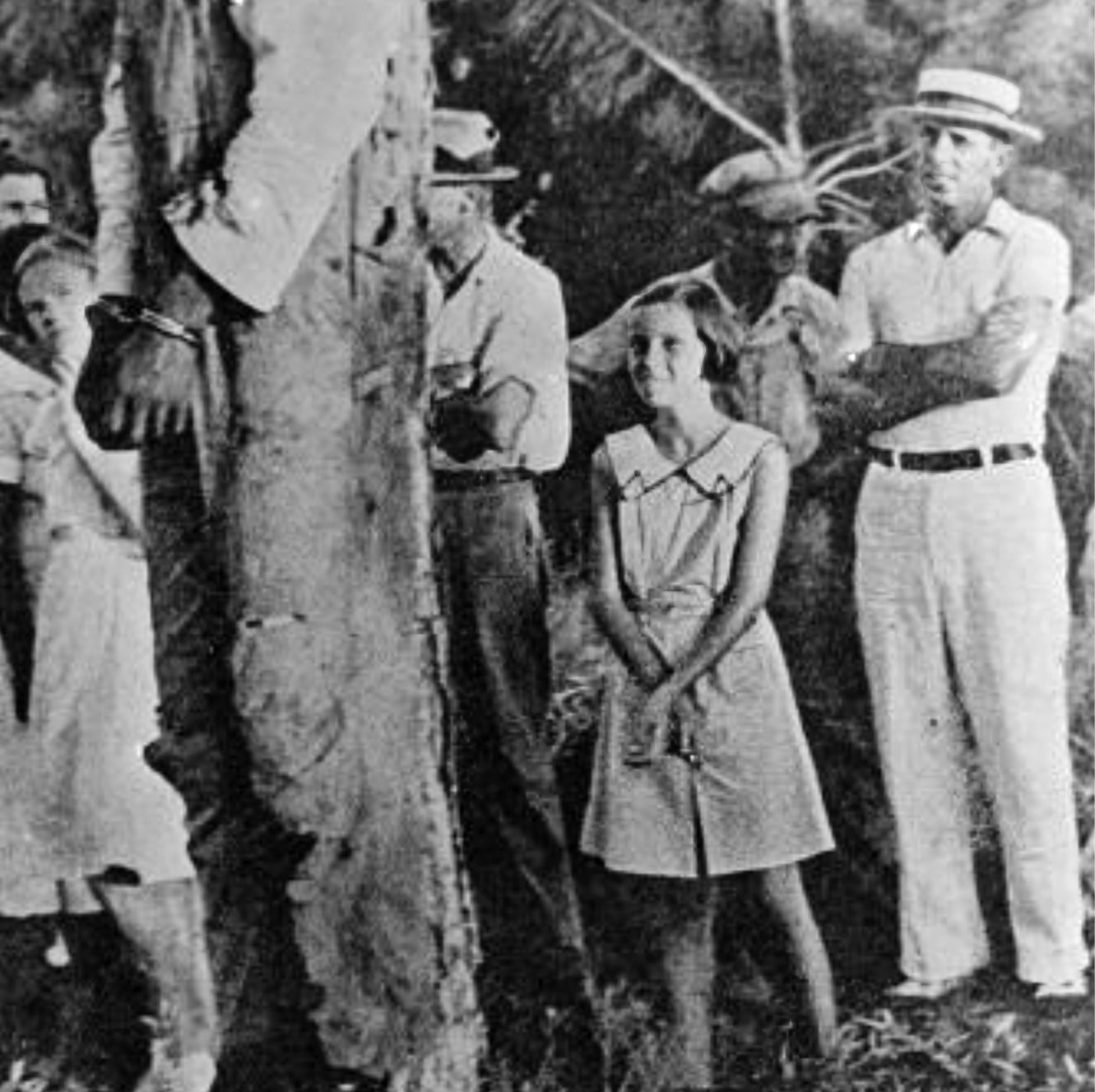
A lynching in America, 1935
The fruits of Krieger’s labor at the University of Arkansas proved most useful to the Nazi-dominated Ministry of Justice and its adjuncts throughout the German government, who were tasked with accelerating the alienation of all Jews in Germany, and who wanted the law on their side to help. “ The Jews in Germany represent a thoroughly extraordinary economic power,” one councillor at the German Ministry of Justice explained that year. “As long as they have a voice in economic affairs in our German Fatherland, as they do now, as long as they have the most beautiful automobiles, the most beautiful motorboats, as long as they play a prominent role in all pleasure spots and resorts, and everywhere that costs money, as long as all this is true I do not believe that they can really be segregated from the body of the German Volk in the absence of statutory law.” So, just regulations enforcing different rules for Jews would not be enough. The Nazis needed to criminalize Jewishness itself. But how, exactly?
Here is where Krieger’s investigation into U.S. law proved to be of most practical assistance. Indian laws, immigration laws, Jim Crow laws in America, were all based on one basic idea: that the “superior” white race must be walled away and protected from all others. If everyone in power agrees on that as your tacit starting assumption and also your ultimate goal, you can Umwege your way there through almost any picayune black-letter dispute. Define the races under law (any vague stab at it will do—judges will know what you mean), mandate the separation of the races or enact any other race-based rule in order to protect one group from the other, and, voilà, the ranking of racial superiority and the justified subjugation of one race by another will be encoded in law firmly enough to empower any racist improvising by the necessary authorities while still giving the impression of legality. With these rules backed up in criminal statutes, state violence could be employed to keep the proverbial peace, to impose domination of one race over another, all under color of law.
America offered so many examples of how it could be done. Yes, the U.S. Constitution had its grandiloquent promise of equal protection of the law, but in practical application that concept yielded easily before the imperative of race protection. You didn’t have, for example, explicit strictures in twentieth-century U.S. law providing that Black Americans and white Americans would have different enumerated rights when it came to marriage. Nevertheless, interracial marriage in much of America was a criminal offense, punishable by fines or imprisonment. Even without a systematic effort to uniformly define “white” or “Black” in some sciencey-sounding way (the Nazis noted that Nevada specifically mentioned “Ethiopians” in its law, while other states referred to “African descent”), just committing to the idea that the criminal law could be used to enforce barriers between the races was enough. Judges would know what to do. All in the well-understood spirit of protecting whiteness from imagined genetic incursion. The explicit assurance of “equal protection” of the law was simply elided, ignored by Americans who invented and sustained these legal constructs, confident that the legal system would allow what was needed, regardless.
Here, for the Nazis, was a template for the taking. The racist goals of the Nazi government were well understood; those values were to be pursued in the law whether the inherited German legal system prescribed or proscribed them. German jurists and Nazi Party officials were encouraged to approach their work, as Whitman notes, “in the spirit of Hitler.”
“ American race legislation certainly does not base itself on the idea of racial difference,” one German criminal law expert noted in a crucial June 1934 internal debate about how to put German law to the task of achieving Hitler’s aims for the Jews. “But to the extent this legislation is aimed against Negroes and others, [it is based] absolutely certainly on the idea of the inferiority of the other race, in the face of which the purity of the American race must be protected.” White Americans, with segregation, were simply protecting themselves against a lesser, alien race “attempting to gain the upper hand.” The Jews in Germany, a senior official in Hitler’s Ministry of Justice explained, “must be kept enduringly apart,” a task that “ can only be achieved through statutory measures that forbid absolutely all sexual mixing of a Jew with a German, and impose severe criminal punishment.”
The American experience in “race protection,” in using the law to create a criminally enforced racially organized social structure, had given Nazi lawyers a great jumping-off point. What followed was their Law for the Protection of German Blood and German Honor, passed in September 1935:
Marriages between Jews and citizens of German or kindred blood are forbidden.
Marriages concluded in defiance of this law are void, even if, for the purposes of evading this law, they were concluded abroad….
Sexual relations outside marriage between Jews and nationals of German or kindred blood are forbidden.
Violators faced a year in prison, hard labor, and fines.
A second law, passed two months later, stripped Jews of German citizenship and all political rights. A Jew, as defined by this new statute, was “anyone who is descended from at least three grandparents who are racially full Jews” or anyone “who is descended from two full Jewish grandparents if (a) he belonged to the Jewish religious community at the time this law was issued, or joined the community later, (b) he was married to a Jewish person, at the time the law was issued, or married one subsequently, (c) he is the offspring of a marriage with a Jew, which was contracted after the Law for the Protection of German Blood and German Honor became effective, (d) he is the offspring of an extramarital relationship with a Jew, and will be born out of wedlock after July 31, 1936.”
THE OTHER NOTABLE move the Nazi-controlled Reichstag made at its session in September 1935, as Whitman points out, was to formally adopt the swastika as the official symbol of the new Germany. The swastika had long been the symbol of the Nazi Party, but now the national legislature was weighing the adoption of the swastika as the emblem of the German nation. The United States figured in that decision too. Back in July of that year, while the head Nazis were still settling on their new flag’s final design, a powerful new German ocean liner, the SS Bremen, entered its berth at Pier 86 in New York, flying an outsized swastika. Plenty of people in America already understood exactly what the insignia represented. A crowd of nearly two thousand New Yorkers, variously described in the ensuing police and newspaper reports as “rioters” or “Communist sympathizers,” gathered to demonstrate displeasure. The melee briefly turned violent. The protesters beat one police officer; a city detective shot one of the demonstrators in the groin.
Five of the protesters managed to board the Bremen, fend off the ship’s crew, haul down the flag, and toss it unceremoniously into the Hudson River. The crowd roared approval. “ What a beautiful sight it was,” said one young American woman who was there that night, “to see the flag, in the spotlight, go downriver.” German officials were incensed and lodged an official protest through diplomatic channels. The U.S. Department of State released a statement offering regret that the “German national emblem” had not “received the respect to which it was entitled.”
The Germans were even more livid when a local New York City magistrate released all but one of the flag maulers without sanction from the notorious holding prison the Tombs and then used the occasion to lecture Adolf Hitler and company. Judge Louis B. Brodsky went out of his way to explain that many regarded this new emblem of Germany as a “black flag of piracy” and believed that the SS Bremen had engaged in a “gratuitously brazen flaunting of an emblem which symbolizes all that is antithetical to American ideals of the God given and inalienable rights of all peoples to life, liberty, and the pursuit of happiness.” The judge’s long speech from the bench took aim at the Nazis’ “war on religious freedom…the suppression of the blessed trinity of free speech, freedom of the press and lawful assembly, the degradation of culture, an international menace threatening freedom; a revolt against civilization—in brief, if I may borrow a biological concept, an atavistic throw-back to premedieval, if not barbaric, social and political conditions.”
The German ambassador issued another formal protest in response. The Nazi commissar of justice railed against “the characteristic Jewish impudence of Magistrate Brodsky of New York,” crowing that “the time is past that the German people can be insulted by Jews.”
The U.S. secretary of state, Cordell Hull, somehow felt obliged to apologize to Germany for Judge Brodsky, calling the judge’s opinion “unfortunately” worded and saying that from the perspective of the U.S. government “it is to be regretted.”
The Nazi minister of propaganda, Joseph Goebbels, confided to his diary that week, “The Judge Broudski [sic] in New York has insulted the German national flag…. Our answer: In Nuremberg the Reichstag will meet and declare the swastika flag to be our sole national flag.” In his speech introducing the laws, Hermann Göring denounced Judge Brodsky by name and called him an “uppity Jew.” Hitler took time in his own Nuremberg speech to publicly thank President Franklin Delano Roosevelt and his administration for being “thoroughly decent and honorable” in denouncing Brodsky’s recent comments. But he also took time to suggest that if the United States and its friends didn’t bring “international Jewish agitation” to heel, the laws in the Reich might become even more harsh.