CHAPTER ONE
THE GLASS HOUSE
The reedy and excitable twenty-six-year-old recent Harvard graduate, full of anticipation, was motoring out to an open field in Potsdam, Germany, to attend a Nazi youth rally. Part of the draw for the Harvard man was the chance to see and hear, in person, Adolf Hitler, who was then still several months away from ascending to the chancellorship of Germany but already the talk of Europeans and Americans in the know. Another factor in the draw to Potsdam was the opportunity to witness up close the dazzling spectacle reliably on display at Nazi rallies. The American aesthete, who would eventually achieve his own considerable level of celebrity both at home and abroad, was keenly interested in the power of artifice.
The young man had been a lonely outsider, lacerated by cruel juvenile humor for much of his life. He was frail and a stutterer and suffered from a low-grade bipolar disorder called cyclothymia. The accompanying “nervous breakdowns” had already slowed his progress in life. Yes, he went to Harvard, but although he entered with the class of 1927, he did not receive his bachelor of arts until three years after most of his classmates, in June 1930.
Still he had gradually adopted the carriage of a man above it all, buoyed in no small part by the precepts adopted from his favorite philosopher, Friedrich Nietzsche. Nietzsche’s siren song was really just one blaring note, and hard to misapprehend: The mass of men was a sorry lot whose most useful quality was the ability to conform to rules others wrote for them. But, the celebrated nineteenth-century German scholar posited, there was a small squadron of elites, of demigods, of Übermenschen (in English, roughly “supermen”) capable of molding the world and all its human glories because they refused to be bound by convention or morality or man-made law.
The Harvard man had been raised with what he called “rather an upper class feeling” about things, so he not only was on the lookout for these predestined few, the rare Übermenschen, but suspected he himself would one day be counted among them. He covered any suspicions of his own “inferiority,” one close acquaintance theorized, by being “personally aggressive.”
The menacing martial snap and guttural roar of that Potsdam youth rally in the fall of 1932 turned out to be something akin to a tent revival for the young American, a political awakening doubtlessly intensified by the invigorating sight—he would later tell his biographer—of “ all those blond boys in black leather” parading by.
The leader of the Hitler Youth, beefy and baby-faced, introduced Hitler to a field of thirty thousand Jugend sporting matching brown uniforms, armbands with the new national emblem, and, pinned over the left breast of the lucky few who could afford it, a weighty metal badge stamped with swastika and sword.
Fifty thousand onlookers in the overflowing stadium watched as Hitler came to the stage. Children waved hundreds of big Nazi flags, and the crowd roared. “We must learn once more to feel as a nation and act as a nation if we want to stand up before the world,” the führer of the future told his rapt audience. “Let no German boy ever bow to an injustice—be proud and defiant and never yield…. Never abandon your people and be more faithful than ever if [the fatherland] is in the greatest distress and danger.” A reporter in attendance noted that Hitler had to pause here, for several minutes, while the crowd sounded its approval. “Through our movement a new and strong generation is growing up that has new courage and does not surrender.”
“ You simply could not fail to be caught up in the excitement of it, by the marching songs, by the crescendo and climax of the whole thing,” the young American would say of that day, decades later. He was struck by the notion that Adolf Hitler might just be the Über-Übermensch, the figure to reshape politics in Germany and beyond. He was also struck with the feeling that he, Philip Johnson, was somehow destined for his own role in this epochal undertaking.
Philip Johnson would go on to become a shaper of sorts, as one of the world’s best-known architects. He would dream up and create sleek, dark, unornamented urban skyscrapers that were widely mimicked, as well as his near-miraculous Glass House, never again tried. But in 1932, on that day in Potsdam, Johnson’s machined glass-and-steel reputation was all in the future; this was long before he took up his actual life’s work as an architect, before he was famous and fêted and seated at the epicenter of midtown Manhattan’s power tables at the Four Seasons Grill Room (he helped design that restaurant too). Back in 1932, on his return to New York from the Hitler Youth rally that stirred his soul, young Philip Johnson’s dream was to bring Hitler-style fascism to America.
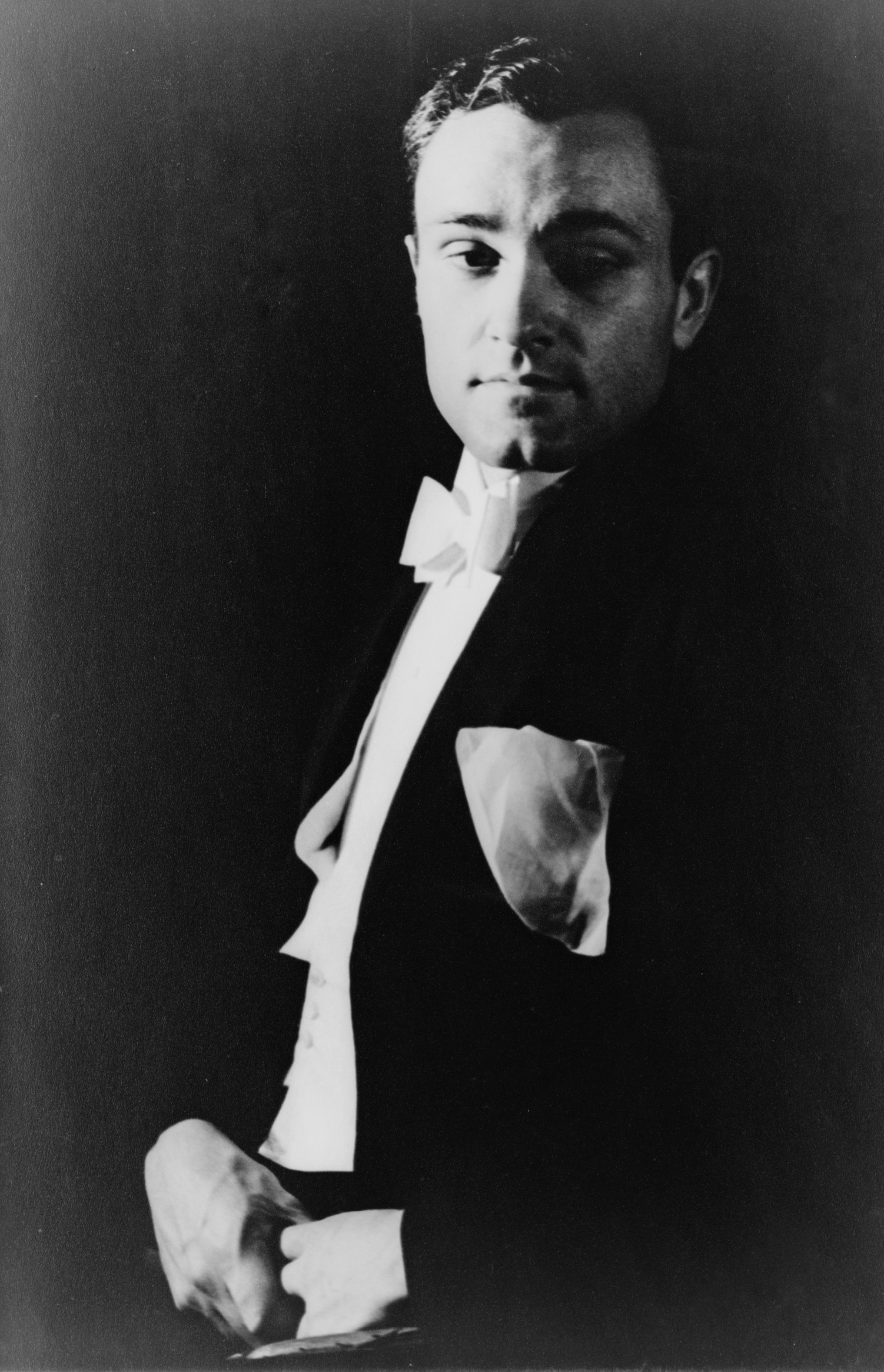
Philip Johnson in the early 1930s
Johnson’s prospects for leading a popular fascist movement to refashion American culture, politics, and government seemed exceedingly dim to those who knew him best. He was “ pulsating with new ideas and hopes…was wildly impatient, could not sit down,” one of his few admirers recalled. But his incessant “quickness and vibration,” she implied, could also be grating. Some contemporaries suspected that Johnson would be a man without close friends or even suitable employment, were it not for his money. Philip Johnson had plenty of money. When he was still an undergraduate at Harvard, his father had gifted him a boatload of preferred stock in the Aluminum Company of America (later Alcoa). The stock threw off an annual dividend income of anywhere from $20,000 to $100,000 a month (in today’s dollars), depending on the American economy’s own bipolar boom-or-bust rhythms.
Johnson picked up a lot of tabs, which often got him what he desired. While not (yet) a practicing architect himself, he became a high-wattage presenter and popularizer of the architectural work of others. He co-curated and provided funding for Modern Architecture: International Exhibition and also Machine Art, two groundbreaking shows at New York’s fledgling Museum of Modern Art introducing Americans to the latest European industrial design and designers. This gave him the chance to celebrate the men he deemed the Übermenschen of modern architecture—Walter Gropius, Le Corbusier, and Ludwig Mies van der Rohe among others. He became the head of the Department of Architecture at MoMA, perhaps in part because he could furnish his own salary. He also paid the salary of his personal assistant, and the MoMA librarian, and the publicity director he hired on, Alan Blackburn, who was one of Johnson’s few intimate friends from boarding school and Harvard.
His efforts to curate and fund American-style fascism did not run quite as smoothly. Johnson had a lot going on in the early 1930s. He had his job at the museum to tend, as well as negotiations for a retail concession (tentatively named Art, Inc.) in the new Rockefeller Center, inveigling efforts to make himself interior designer to the smart set’s filthy rich, and a whirling social life. On warm summer nights Johnson would drive up to Harlem in a friend’s open-top Chrysler sedan for assignations with a beautiful and honey-voiced African American cabaret singer. Jimmie Daniels was “a beautiful, beautiful kid,” Johnson would wistfully recall years later. The two would stay overnight at an uptown boardinghouse whose owners knew the score. “I tried to have him downtown,” Johnson would say. “It didn’t work so well.”
He and Alan Blackburn often invited friends over to Johnson’s duplex apartment, which doubled as a showroom for Mies van der Rohe’s modern designs. There, they could belittle President Roosevelt and his milquetoast New Deal all they wanted, or talk of the day when the United States had a bold leader like Hitler. Johnson started compiling a list of young men and women who seemed sympathetic to an American Hitler, and maybe even willing to join his and Blackburn’s new organization, the Gray Shirts. (Johnson conceived the Gray Shirts as an American counterpart of Hitler’s menacing tip-of-the-spear storm troopers, or Brownshirts, both in style and in substance.) He entrusted this secret list to his personal assistant, Ruth Merrill, and told her to never let it out of her sight. She said the list grew to somewhere between two hundred and three hundred names, though no more than twenty ever showed up at actual meetings of the Gray Shirts.
Miss Merrill regarded the enterprise, right down to the occasional German-language-only get-togethers and Johnson’s hiring of a German manservant, Rudolph, as what we now call cosplay—overgrown boys in dress-up. Philip had “a weak character and [an] immature mind,” she said. This view was widely shared among people who knew Johnson well; they described him as “flighty” or “rather silly” or “too much of a fool to worry about.” Philip Johnson was “harmless,” concluded the sheriff of the county in Ohio where Johnson grew up and kept a home. “[ He] just has a lot of money and nothing to do but travel around and spend, being a nuisance to himself and everyone else.”
There was one figure among Johnson’s art world acquaintances who was less forgiving of his antics. Philip’s “ only real passion,” Lincoln Kirstein explained, “was to exert power to tell people what they want.”
Kirstein was a mirror image of Philip Johnson from most angles: an almost exact contemporary, Harvard educated, independently wealthy thanks to his father, bisexual, an unflinching aesthete, and a budding arts impresario. While at Harvard, Kirstein had founded the Society for Contemporary Art on campus, as well as a literary magazine that published new poetry by e. e. cummings, T. S. Eliot, Edmund Wilson, and Ezra Pound—before Pound was revealed as a committed fascist himself. While Johnson spent the first years of his professional life introducing Europe’s modern design and architecture to America, Kirstein was busy creating an American ballet troupe to rival the best in Europe.
But Kirstein was different from Philip Johnson in one very consequential respect: He was Jewish.
Kirstein’s father was close friends with the Harvard law professor Felix Frankfurter, who was already ringing alarm bells in the halls of power in the United States about the unfolding brutality of the Nazis’ rule in Germany. Frankfurter spent the 1933–34 academic year at Oxford University in England, where he had a closer view of developments in Europe. “The air here [in England] is charged, albeit in a sober kind of way, with the kind of feeling that preceded 1914,” Frankfurter wrote to his friend President Franklin Delano Roosevelt. He also forwarded the president letters from a League of Nations commissioner describing the enormity of recent Nazi decrees making Jews second-class citizens in Germany. In April 1934, Frankfurter published one of the first articles detailing the early consequences of Hitler’s Aryan-only policies, which included stripping many Jewish professionals of their positions in academia, law, and medicine. “There is no doubt,” Frankfurter wrote, “that the Jew in Germany is doomed.”
Lincoln Kirstein could sense ill winds blowing across the Atlantic and into the kinds of upper-class salons of Manhattan that welcomed rich, influential young men like him and Philip Johnson. At a stylish loft on East Fortieth Street one night in 1934, when a wealthy socialite was in her cups and suddenly free from inhibition, she lashed out at a fellow partygoer, who happened to be Jewish. “You live on corruption!” she yelled. “You all ought to be extirpated.” The gathering’s bohemian hostess described the scene to Lincoln Kirstein the next day. She initially appeared distraught and confided to her young friend that she was afraid that the ugly scenes playing out in Germany “might happen here in America.” But she gradually talked herself out of anxiety. The drunk malefactor, she finally explained to Kirstein, was probably overwrought because she had been unsuccessful in her headlong attempts to seduce a man named Lawrence Dennis.
IT WAS PROBABLY no surprise to Kirstein that Lawrence Dennis, an enthusiastic kochleffel (pot stirrer), had set the scene in motion. Dennis was a handsome, well-traveled, and unusually compelling figure—a Harvard man like Philip Johnson and Lincoln Kirstein, but a generation older, and with a somewhat mysterious (or at least somewhat fuzzy) life history. He was a former U.S. State Department hand, a sometime stockbroker, an amateur economist, and a political gadfly masquerading as a deeply intellectual theorist.
Dennis’s forceful, erudite personality and his rugged, square-jawed good looks had caught the eye of many an excitable middle-aged woman, not to mention Philip Johnson and Alan Blackburn. The incipient urban fascists invited Dennis to lecture at the secret meetings of their still closeted Gray Shirts anytime he was free, and they took his oracular pronouncements to heart. Dennis had invested early in the possibilities of American-style fascism, and he clearly relished the prospect of a violent turning of the tables. “ I ask no sympathy and would resent an indication of pity just as I would have neither sympathy nor mercy on thousands of people now in the seats of the mighty if I came to power,” Dennis wrote privately to a friend in 1933, on seeing up-from-nothing Hitler take over the chancellorship of Germany. “I should like nothing better than to be a leader or follower of a Hitler who would crush and destroy many now in power. It is my turn of fate now to suffer. It may someday be theirs.”
Lawrence Dennis advised Johnson and Blackburn, their handful of fellow Gray Shirts, and anybody else who was listening that if they wanted a fascist government in America they were going to have to play the long game. The best vehicle for that faraway future, as far as Dennis could see, was a recent governor and current U.S. senator from the state of Louisiana, Huey Long. “ Smarter than Hitler,” Dennis said. “The best example of our nearest approach to a national fascist leader.” He also said, characteristically cocksure, “Long reads my stuff.”